
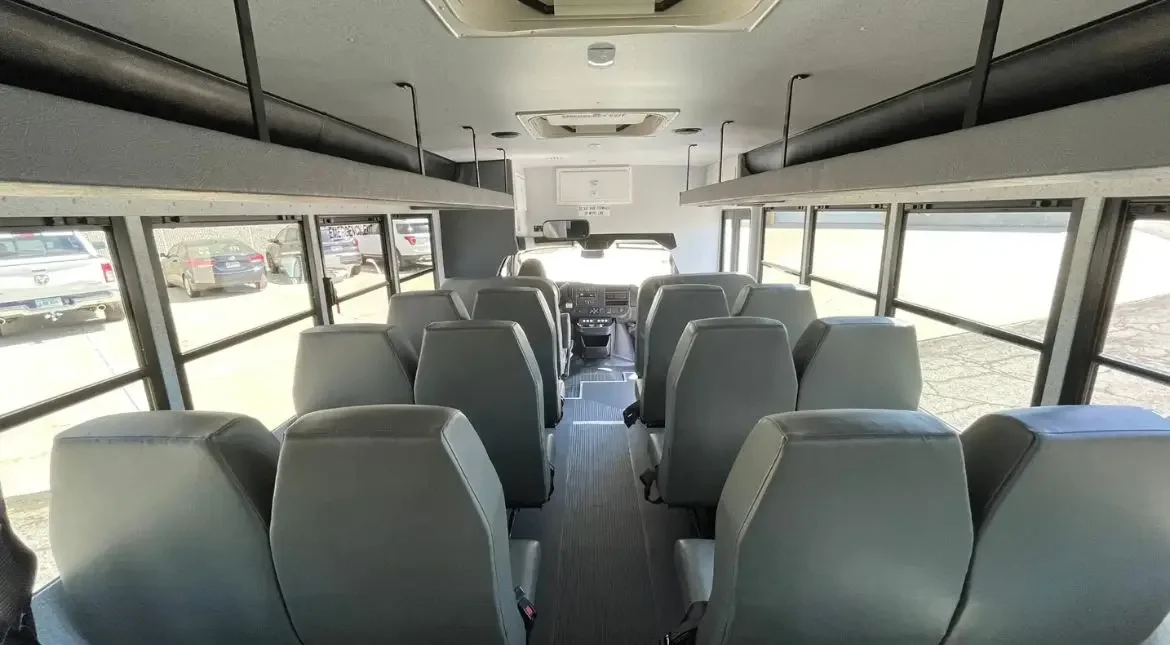
The 14-passenger range sits at a specific intersection of capacity and maneuverability that makes it the default choice for senior living facilities, non-emergency medical transport operators, and special education programs. It's large enough to justify a dedicated vehicle on regular routes, compact enough to navigate facility driveways, hospital drop-off lanes, and tight urban streets — and when ADA accessibility is a requirement, the configuration decisions around lift placement and wheelchair securement become as important as the seat count.
Endera builds compact ADA-ready shuttles across its B-Series commercial lineup, with 800 lb Braun lift options, wheelchair securement systems, and flat-floor configurations available on both gasoline and electric models. Current in-stock units include 12+2 and 8+4 flat-floor configurations on the 2026 Ford E450 chassis.
Your passengers need more than a seat count — connect with an Endera specialist today to configure a shuttle built around your accessibility requirements.
What ADA-Ready Actually Means on a Shuttle Bus
"ADA-ready" is a term buyers encounter frequently — and it covers a specific set of federal requirements, not a general quality claim. Under DOT ADA regulations and the Access Board's vehicle accessibility standards, a compliant shuttle bus must include a boarding device (lift or ramp), at least one wheelchair securement location for vehicles 22 feet and under, and a two-part securement system consisting of a wheelchair restraint and a seat belt and shoulder harness for the wheelchair user.
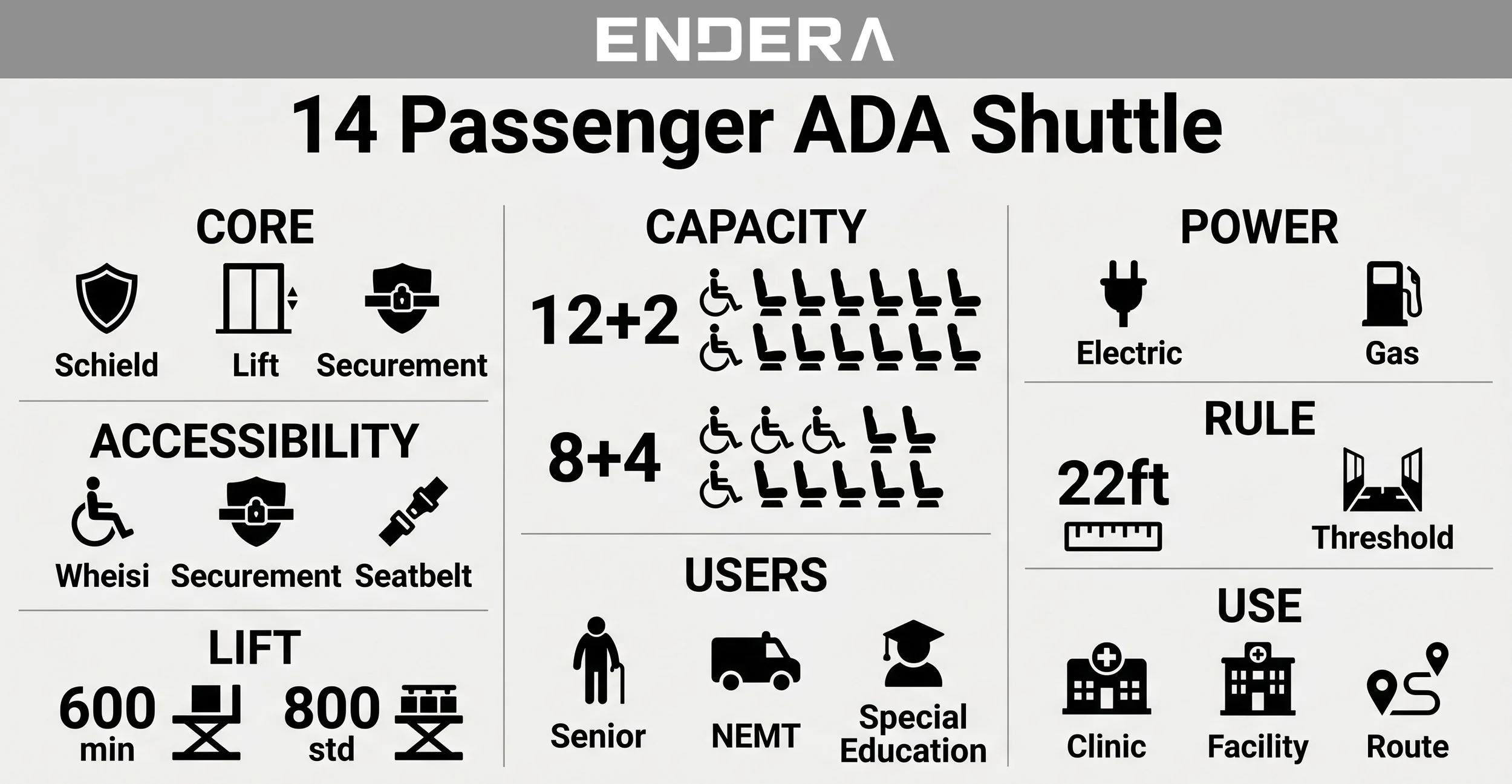
The lift design load requirement is equally specific: under federal standards, vehicle lifts must support a minimum design load of 600 pounds. This covers the combined weight of the passenger and mobility device and applies regardless of the lift brand or model. Endera's standard configuration includes the Braun 800 lb lift — rated 33% above the federal minimum — across applicable B-Series configurations.
The 22-Foot Threshold: One vs. Two Securement Positions
Federal ADA regulations draw a meaningful line at 22 feet of vehicle length. Under 49 CFR Part 38, vehicles over 22 feet must provide securement locations and devices for at least two wheelchairs. Vehicles 22 feet and under are required to accommodate at least one.
This distinction matters for buyers in the 14-passenger range because Endera's B3 model sits at 23 feet — just over the threshold — which triggers the two-securement requirement. Buyers configuring for wheelchair transport should factor this into their seating layout calculations, since each securement position displaces standard passenger seats. Flat-floor configurations with fold-down seats in the securement area allow those positions to accommodate standard passengers when no mobility device is present.
Capacity Configurations for ADA Operations
ADA-configured shuttles trade some standard passenger capacity for wheelchair securement space. Understanding the actual capacity in mixed-use configurations helps buyers right-size the vehicle for their typical load before ordering.
| Configuration | Standard Seats | Wheelchair Positions | Total Capacity |
|---|---|---|---|
| 12+2 flat-floor | 12 | 2 | 14 (mixed) |
| 8+4 flat-floor | 8 | 4 | 12 (mixed) |
| 14 passenger standard | 14 | 0 | 14 (no lift) |
The 8+4 configuration is the most common choice for operations where wheelchair passengers make up a consistent portion of daily ridership — NEMT providers, senior living facilities, and adult day programs. The 12+2 configuration suits operators where wheelchair transport is occasional rather than routine, preserving maximum standard seating capacity while maintaining full ADA compliance.
Who Uses 14-Passenger ADA Shuttles
The buyer profile for compact ADA shuttles is distinct from general commercial shuttle operators. Senior living communities and assisted living facilities are the primary purchaser — they run daily transport to medical appointments, day programs, and community activities where wheelchair accessibility isn't a preference but an operational requirement. Non-emergency medical transport (NEMT) contractors are the second major segment, particularly those serving Medicaid populations where accessible vehicle requirements are built into the service contract.
Special education programs also operate in this segment — smaller group transport for students with mobility needs where a full-size school bus is unnecessary and a van falls short of the safety and accessibility standards required. ADA regulations require that transportation providers serving passengers with disabilities make accessible vehicles available, and that operators provide assistance including securement when requested — obligations that apply to private operators as well as public transit.
ADA Compliance for Private Shuttle Operators
A common misconception is that ADA vehicle accessibility requirements only apply to public transit agencies. Under FMCSA accessibility regulations and DOT ADA standards, private transportation operators providing service to the public are also subject to accessibility requirements. This includes private shuttle operators running fixed routes, demand-responsive services, and contracted transportation programs.
For operators running NEMT contracts, senior living transport, or any service where the contract or licensing requires accessible vehicles, purchasing a non-ADA-configured bus creates both a compliance gap and a service liability. New fixed-route transit vehicles must be accessible under federal rules — making the ADA lift and securement system a procurement requirement, not an optional add-on.
Electric vs. Gasoline in the Compact ADA Range
ADA configuration is powertrain-agnostic — the lift, securement system, and flat-floor layout are available across Endera's gasoline and electric B-Series models. For operators evaluating electric, the compact ADA use case aligns well with electric's operational profile: most senior living, NEMT, and special education routes are predictable, short-distance, and return to a central facility each day — exactly the conditions where overnight charging is practical and per-mile operating cost savings accumulate consistently.
Endera's proprietary all-electric powertrain places battery packs within the frame rails, which preserves interior floor clearance critical for wheelchair securement layouts and maintains the low step-in height that ADA passengers require. Financing options cover both powertrain types, and grant navigation assistance is available for operators whose purchase may qualify for clean vehicle incentives.
Built Around the Passenger, Not the Seat Count
Compact ADA shuttle procurement is ultimately a configuration exercise — matching the wheelchair position count, fold-down seat layout, lift placement, and powertrain to the specific passenger profile of the operation. A senior living operator running three wheelchair users per trip needs a different layout than an NEMT contractor running one at a time on demand-responsive routes.
Get the configuration right before the build order goes in. Contact Endera's sales team today to walk through layout options, review in-stock availability, and confirm which ADA configuration fits your daily ridership profile.
Frequently Asked Questions
What is the minimum lift capacity required on an ADA shuttle bus?
Federal ADA standards require vehicle lifts to have a minimum design load of 600 pounds — covering the combined weight of the passenger and mobility device. Endera's standard Braun lift is rated at 800 lbs, which exceeds the federal minimum by 33%. Lift capacity should be verified against the operator's typical passenger and mobility device weight profile before finalizing a configuration.
Do private shuttle operators need ADA-compliant vehicles?
Yes, in many cases. DOT ADA regulations and FMCSA accessibility requirements apply to private transportation providers serving the public, not just public transit agencies. Private operators running fixed-route or demand-responsive services — including NEMT contractors, senior living transport, and private shuttles open to the public — are subject to accessibility requirements. Operators should confirm their specific classification and service type with legal counsel to determine the applicable standard.
How many wheelchair positions does a 14-passenger ADA shuttle support?
This depends on the configuration. Endera's 12+2 flat-floor layout supports two wheelchair securement positions alongside 12 standard seats. The 8+4 layout supports four positions alongside 8 standard seats. Federal ADA regulations require vehicles over 22 feet to provide two securement locations — Endera's 23-foot B3 meets this threshold. Fold-down seats in securement areas allow those positions to serve standard passengers when no mobility device is present.
Can ADA shuttle buses be electric?
Yes. Endera's ADA lift and securement configurations are available on both gasoline and electric B-Series models. The electric powertrain's battery placement within the frame rails preserves the flat-floor interior clearance that wheelchair layouts require. Electric ADA shuttles are particularly well-suited for senior living and NEMT operations with predictable daily routes and central facility charging.
What securement system does an ADA shuttle bus require?
Under DOT ADA regulations (49 CFR Part 38), ADA-compliant buses must have a two-part securement system: one component to secure the wheelchair or mobility device, and a separate seat belt and shoulder harness for the wheelchair user. The system must restrain a forward longitudinal force of up to 2,000 lbs per securement leg. Endera's ADA configurations include compliant securement hardware as standard equipment.
Is there funding available for ADA shuttle bus purchases?
Funding availability depends on the buyer's classification and intended use. Public transit agencies and some NEMT operators may qualify for FTA grants requiring Buy America compliance. Non-profit senior living and disability service organizations may qualify for community development or HHS transportation grants. Electric models may also qualify for clean vehicle incentive programs. Endera's grant navigation team can assess which programs apply to a specific buyer's profile and use case.
What is the difference between the 12+2 and 8+4 flat-floor configurations?
The 12+2 configuration provides 12 standard passenger seats and 2 wheelchair securement positions, making it the better choice when wheelchair transport is occasional. The 8+4 configuration provides 8 standard seats and 4 wheelchair positions, suited for operations where a higher proportion of daily riders use mobility devices. Both use fold-down seats in securement areas to maintain capacity flexibility when wheelchair positions are unoccupied.