
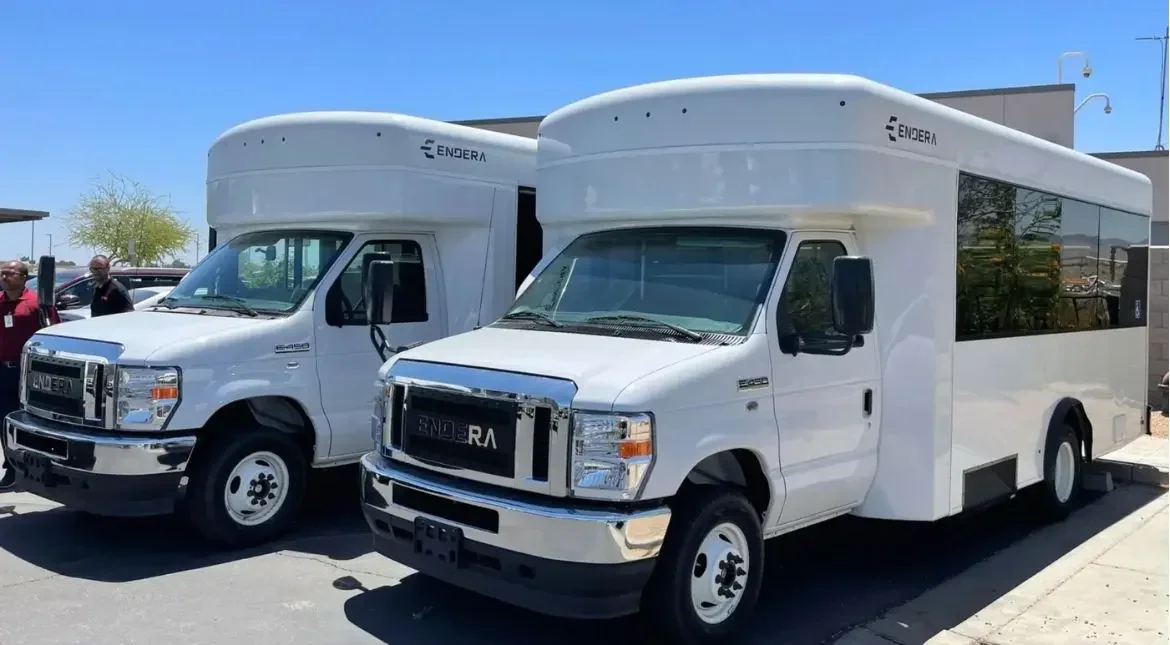
Pennsylvania’s shuttle market is driven by major airports, healthcare systems, universities, and manufacturing corridors across the state. Philadelphia and Pittsburgh anchor the largest ground transport networks, while institutions like Penn State, Pitt, Temple, and major healthcare systems generate steady campus and employee shuttle demand. Endera builds the B-Series commercial shuttle as a complete system — vehicle, powertrain, software, and charging infrastructure — assembled in Ottawa, Ohio with the flexibility to support Pennsylvania’s wide range of operating environments.
Pennsylvania’s EV incentive landscape has expanded significantly, with NEVI funding, Community Charging grants, and utility rebate programs supporting fleet electrification across the state. For airport, university, and healthcare shuttle routes with depot charging access, Endera’s electric B4 and B5 are practical options. For manufacturing employee transport and longer inter-city routes, ICE variants provide greater range certainty. Endera builds both on the same platform to support different operational needs.
Figure out your fleet before the next procurement cycle — Endera's team can walk you through configurations, incentives, and financing for your Pennsylvania operation.
The B-Series Lineup and What Each Model Is Built For
From 23 to 28 Feet, on Proven Platforms
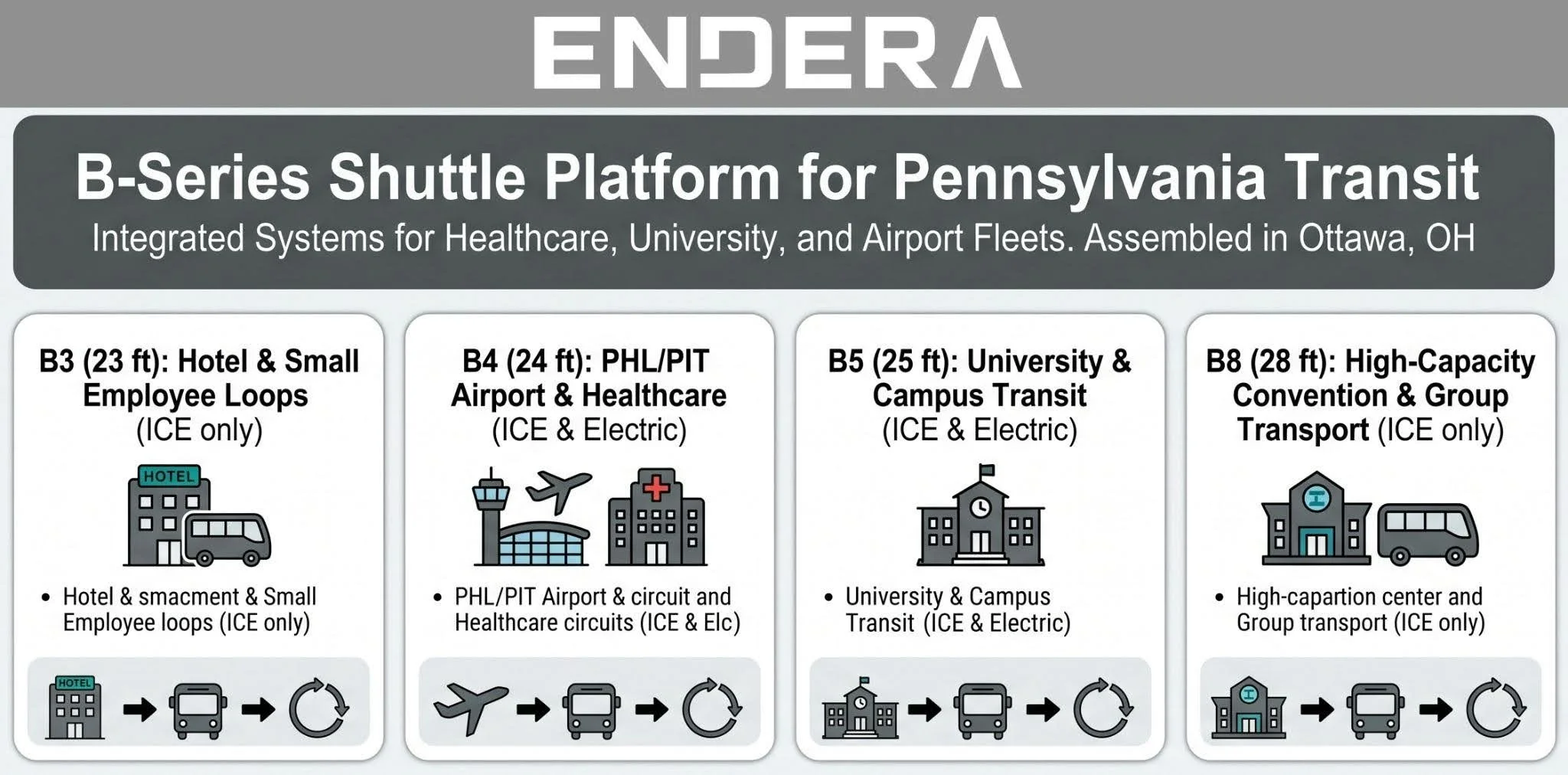
Endera's B-Series runs from 23 to 28 feet, built on the Ford E450 and Chevrolet Express cutaway chassis — platforms with dealer and service coverage across Pennsylvania's major metros and secondary markets. The B3 at 23 feet handles smaller hotel loops and employee shuttles. The B4 and B5 — available in both ICE and electric — cover the mid-size range most used by airports, healthcare campuses, universities, and corporate programs. The B8 at 28 feet handles higher-volume convention and group transport where passenger capacity is the constraint.
ICE or Electric: Pennsylvania's Honest Assessment
Pennsylvania winters create real battery range reduction — operators should plan for meaningful range drops during cold months, and pre-conditioning at depot is the standard mitigation for short-loop EV operations. For Philadelphia-area airport circuits, campus loops at Penn and Temple, and healthcare campus routes with overnight depot access, the electric B4 and B5 perform reliably with proper charging strategy.
For longer routes across the state's interior, multi-shift manufacturing employee transit, and upstate corridors where charging infrastructure is still developing, the ICE models are the more operationally reliable choice. Endera's sales team works through route and depot conditions before recommending a configuration.
What Winter EV Shuttle Operations Actually Require in Pennsylvania
Pennsylvania Spans Multiple Climate Zones — and One Strategy Doesn't Cover All of Them
Winter EV shuttle operations in Pennsylvania are genuinely different depending on where the fleet runs. A Philadelphia airport shuttle operates in a very different environment from a manufacturing employee route outside Erie or a healthcare shuttle climbing Pittsburgh's hill corridors.
The U.S. Department of Energy notes that cold temperatures reduce battery efficiency, slow charging speed, increase cabin heating demand, and reduce regenerative braking performance — with EV range dropping up to 41% in cold mixed-city driving when cabin heat is in heavy use. For Pennsylvania operators, that figure varies significantly by region and route type.
Pre-Conditioning, Depot Strategy, and What NREL Research Shows
NREL research on climate-control loads and EV range found that cabin heating systems can reduce EV range by more than a third, but that thermal pre-conditioning — warming the battery and cabin while still plugged in at depot — can recover up to 19% of that range loss by drawing heating energy from the grid rather than the battery.
For Pennsylvania shuttle fleets, that means structured overnight depot charging and pre-conditioning before morning dispatch are operational requirements, not optional enhancements. Indoor fleet storage also materially improves charging consistency and morning range availability compared with outdoor parking during Pennsylvania's snow and ice events.
Where Pittsburgh's Elevation and Western PA Geography Add Complexity
Pittsburgh's hill corridors introduce the same elevation-related energy dynamics that affect other mountainous shuttle markets — sustained climbs increase energy consumption above flat-road baselines, while descents offer regenerative recovery. For healthcare shuttles climbing between Oakland, the South Side, and Mount Washington, route-specific energy planning matters more than average-mileage estimates.
Western and central Pennsylvania's longer intercity corridors and rural manufacturing employee routes create more exposure to winter range variability, storm-related idling losses, and charging infrastructure gaps than Philadelphia's denser urban environment. PennDOT winter operations maintain 40,000 miles of roads and 25,400 bridges — but during active storms, rural routes are cleared after major highways, which affects EV shuttle operators managing range on routes where unexpected delays add idling time. Philadelphia airport loops, University City healthcare campuses, and campus transit at Penn and Temple remain strong winter EV applications because routes are short, predictable, and depot-supported. Western and central Pennsylvania routes benefit from a route-specific assessment before committing to electric.
How B-Series Compares to Other Pennsylvania-Available Shuttle Buses
The Shared Platform Reality
In Pennsylvania, most shuttle buses share the Ford E450 or GM cutaway chassis, and the differences come down to integration depth, configuration flexibility, and single-vendor accountability. Any shuttle purchased with federal transit funding must meet FTA Buy America requirements, including domestic content thresholds and U.S. final assembly standards — narrowing the field to manufacturers that can certify compliance and support pre-award and post-delivery documentation.
Where Endera Differs — and Where It Doesn't
Competing manufacturers like Starcraft, Turtle Top, and ElDorado operate as body builders on shared chassis — a legitimate fit for operators who prioritize low upfront cost or an existing dealer relationship. Where Endera's B-Series differs is in being a fully integrated platform — vehicle, powertrain, software, and charging infrastructure — from a single manufacturer four to six hours from Pennsylvania's major markets. For high-frequency Philadelphia and Pittsburgh operations where downtime impacts revenue and patient or employee throughput, single-vendor accountability reduces service friction that multi-vendor configurations don't.
Funding and Incentives for Pennsylvania Shuttle Buyers
PennDOT NEVI and Community Charging Funding
Pennsylvania is one of the most advanced states in NEVI deployment. PennDOT received full AFC build-out certification on September 22, 2025, allowing NEVI funds to be deployed on any public road or publicly accessible location statewide — not just designated corridors. In February 2026, Governor Shapiro announced $100 million in NEVI Community Charging funding, with approximately $34 million for southeastern Pennsylvania and additional rounds opening in 2026. Pennsylvania already leads the nation with 31 NEVI-funded stations operational. For shuttle operators whose routes or depots align with expanding PA charging corridors, the network changes the operational feasibility of EV deployment on routes that weren't practical previously.
Duquesne Light, PECO, and Utility EV Programs
Duquesne Light's EV Bonus Cash program provides commercial customers in the Pittsburgh service territory with rebates for EV purchases and charging infrastructure. PECO's commercial EV program serves the Philadelphia region with commercial fleet electrification support. Both utilities also offer time-of-use rates and make-ready infrastructure support that reduce the upfront cost of depot charging for Pennsylvania fleet operators. Endera's turnkey charging infrastructure offering coordinates with these utility programs so operators manage one procurement process rather than two.
FTA Programs and the DEP VW Settlement
For transit agencies and eligible operators pursuing the electric B4, the FTA Low or No Emission Vehicle Program remains the primary federal funding pathway. Pennsylvania's DEP-administered VW Mitigation Trust funds have supported transit and school bus replacement across the state — operators replacing aging diesel shuttles should confirm current DEP program availability with Endera's team, which assists with identifying applicable funding and managing applications directly.
Endera's Software Stack: What It Does for Pennsylvania Fleet Managers
Real-Time Visibility for Passengers and Operators
Every Endera B-Series shuttle comes available with two integrated software tools built in-house. Endera Go gives passengers real-time vehicle location, ETA updates, and occupancy data — directly relevant for healthcare campus shuttles, airport ground transport, and university transit where wait time affects the passenger experience. Endera Dispatch handles fleet management: routing optimization, vehicle health analytics, and state-of-charge monitoring for EV operators.
No Third-Party Integration Required
Both tools are integrated directly with the vehicle's hardware — no separate telematics license, no integration project, no data gap between what the vehicle is doing and what the software reports. For Pennsylvania operators managing fleets across multiple facilities or complex shift schedules, real-time visibility is operationally useful every shift. The cost-per-mile and utilization data Dispatch generates also supports the reporting requirements that come with federally funded procurement and utility rebate documentation.
Pennsylvania Shuttle Operations Span Two Major Metros, a Large University System, and One of the Country's Most Active Healthcare Corridors
From PHL airport loops and University City campus shuttles in Philadelphia to UPMC employee transport and Carnegie Mellon campus transit in Pittsburgh, Pennsylvania shuttle operations cover a wide range of institutional environments and operating conditions. Endera's B-Series is built as a complete system — vehicle, powertrain, software, and charging infrastructure — by one manufacturer close enough to Pennsylvania's major markets that delivery and service response are both realistic, in ICE and electric variants that let operators match the fuel type to the route.
See what's available for your operation — configurations, current stock, and applicable funding for Pennsylvania buyers.
FAQs
1. What B-Series models are available for Pennsylvania buyers?
The B-Series runs from the B3 (23 feet) through the B8 (28 feet). The B4 and B5 are available in both ICE and electric. The B3 and B8 are currently ICE only. Endera's sales team can confirm availability and lead times for Pennsylvania delivery.
2. How does Pennsylvania's winter climate affect EV shuttle performance?
Pennsylvania operators should plan for meaningful battery range reduction in winter months. For Philadelphia-area campus loops and airport circuits with overnight depot access and pre-conditioning, the electric variants work reliably. For longer inter-city routes and multi-shift manufacturing operations without depot access, ICE models are the more reliable choice.
3. What is COSTARS and can Pennsylvania public entities use it for shuttle purchases?
COSTARS is Pennsylvania's cooperative purchasing program, allowing local governments, school districts, and qualifying nonprofits to purchase from pre-competed DGS contracts without a full competitive bid process. Endera's team can support operators through COSTARS-eligible procurement pathways.
4. Does Endera provide charging infrastructure for Pennsylvania EV buyers?
Yes. Endera provides full turnkey charging infrastructure — site assessment, charger sourcing, and installation — coordinating with Duquesne Light and PECO utility rebate programs for operators in Pittsburgh and Philadelphia service territories.
5. How does Pennsylvania public procurement work for shuttle buses?
State agencies procure through the DGS Bureau of Procurement. Local entities use COSTARS. Federal transit funding purchases are subject to FTA requirements. Pennsylvania state agencies are required to replace 25% of passenger car fleets with EVs by 2025.
6. What software comes with a B-Series shuttle?
Every B-Series shuttle comes available with Endera Go and Endera Dispatch — real-time tracking, fleet management, routing, and vehicle health analytics — integrated directly with the vehicle's hardware.
7. Does Endera offer financing for Pennsylvania buyers?
Yes. Endera offers direct financing and capital leasing through its financing platform. Capital leasing preserves working capital and aligns vehicle costs with revenue cycles. Endera also assists with grant identification and application management.