
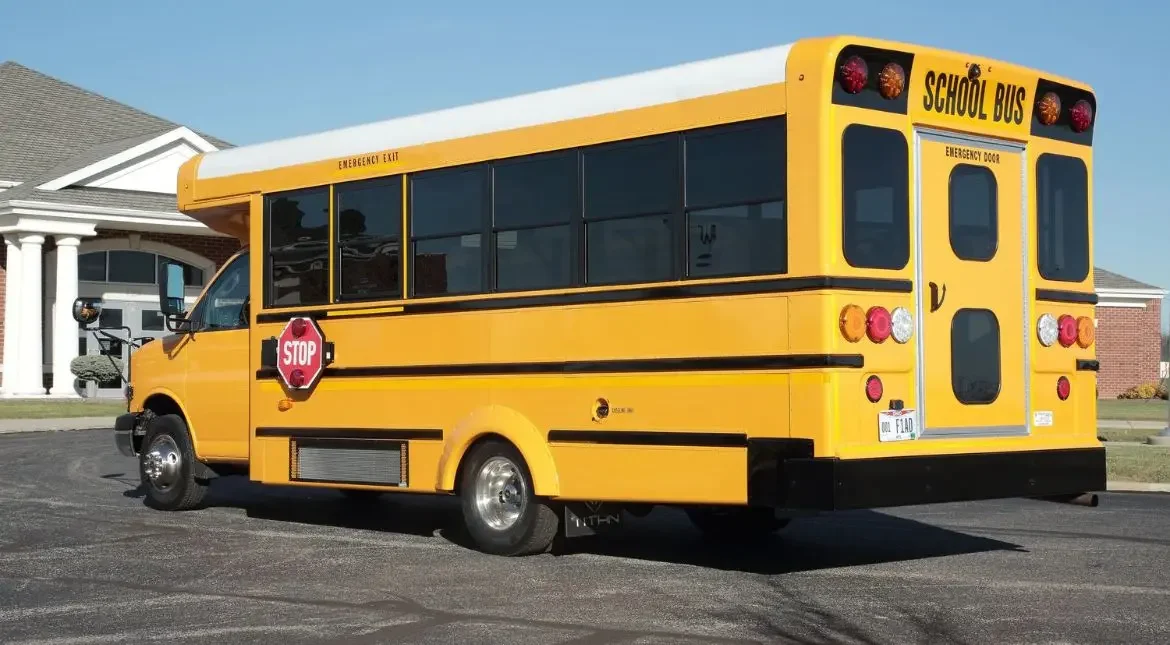
Michigan's commercial shuttle market runs the full spectrum — Detroit Metro airport operators, university campus circulators at Ann Arbor and East Lansing, corporate campuses in the automotive corridor, and hotel fleets serving convention traffic across the state. Each use case has different range requirements, different fueling infrastructure, and a different calculus on whether the state and federal incentive landscape makes electric the financially smarter choice right now or in the next procurement cycle.
Endera builds B-Series commercial shuttles in gasoline, propane, CNG, and electric configurations on the Ford E450 cutaway chassis, from its Buy America compliant manufacturing facility in Ottawa, Ohio. All models ship to Michigan buyers through Endera's national dealer network anchored by Pritchard Companies.
Whatever your Michigan operation looks like, there's a B-Series configuration built for it — connect with an Endera specialist today to find it.
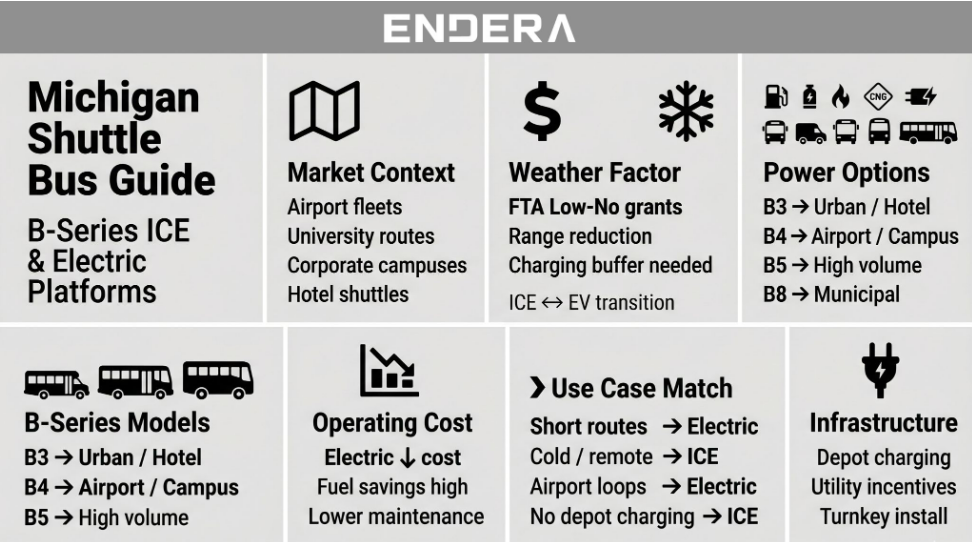
Michigan's Transit Funding Landscape for Shuttle Operators
Michigan transit agencies and shuttle operators have access to significant federal funding through the FTA's Low or No Emission Grant Program, which funds the purchase or lease of zero-emission and low-emission transit buses along with supporting infrastructure including charging and maintenance facilities. Michigan transit authorities received $72.5 million in FTA Low-No and Bus Program grants in July 2024, and the state received an additional $133 million in December 2025 through the same federal programs.
For commercial shuttle operators that operate as public transit providers or under contract with transit agencies, these programs can offset a significant portion of vehicle and infrastructure acquisition cost. Eligibility depends on organizational classification and how the service is structured — Endera's grant navigation services assess which programs apply to a specific buyer's profile.
Electric vs. ICE in Michigan: The Cold Weather Question
Michigan's winters are the variable that every electric fleet evaluation must address honestly. Sub-zero temperatures reduce battery range — heating demand can cut effective range by up to 40–50% in extreme cold — and operators running airport loops or campus routes during January in Detroit or Traverse City need to plan charging buffers accordingly.
When Electric Works Year-Round
The practical rule: if daily route mileage plus a 30% weather buffer falls within the battery's rated range, electric is operationally viable year-round in Michigan. For Endera's B4 electric, this covers most urban and suburban shuttle operations running under 80 miles per shift.
When ICE Is the Safer Choice
For operations with longer exposure to extreme cold, less predictable daily mileage, or no fixed depot charging, gasoline or propane provides operational reliability without range planning complexity. Propane cuts fuel spend by 30–40% versus gasoline while eliminating the charging infrastructure requirement entirely.
B-Series Models for Michigan Shuttle Operations
Endera's B-Series covers 23–28 feet across four models, with the B3 and B4 being the most common configurations for Michigan's mid-capacity shuttle market.
| Model | Length | Fuel Options | Michigan Use Case |
|---|---|---|---|
| B3 | 23 ft | Gasoline | Hotel shuttles, tight urban routes, small campus loops |
| B4 | 24 ft | Gasoline & Electric | Airport parking, university circulators, corporate campuses |
| B5 | 25 ft | Gasoline & Electric | High-frequency employee transport, larger campus operations |
| B8 | 28 ft | Gasoline | High-demand municipal transit, event transport |
The B4 electric holds an Altoona durability test score of 90.1 — the highest in its class — which is the FTA's required certification for federally funded transit vehicle procurement. For Michigan operators pursuing Low-No Program grants, that certification is a procurement prerequisite.
Operating Cost: ICE vs. Electric in Michigan Fleet Operations
The financial case for electric shifts once total operating cost replaces sticker price as the comparison metric. Michigan fleet data from school bus operators provides a relevant proxy: diesel shuttle operations in Michigan fleet studies run approximately $0.79 per mile in fuel costs, while comparable electric operations run approximately $0.14 per mile — a roughly 82% per-mile fuel cost reduction.
For an airport or hotel operator running 30,000 miles annually per vehicle, that difference equals approximately $19,500 in annual fuel savings per bus. Across a five-vehicle fleet over an eight-year service life, the electric powertrain's operating cost advantage compounds to over $750,000 — before factoring in reduced brake wear from regenerative braking and the simpler drivetrain maintenance profile of an electric motor versus an internal combustion engine.
Charging Infrastructure for Michigan Shuttle Fleets
Michigan utilities including Consumers Energy and DTE Energy offer fleet electrification advisory programs and infrastructure incentives for commercial operators installing EV charging at facilities. These programs provide site assessment support, rate structure guidance to minimize time-of-use charging costs, and in some cases direct infrastructure rebates.
Endera's turnkey EV platform covers site assessment, DC fast charging station procurement, metering installation, and demand-based charging schedule optimization through Endera Dispatch. For Michigan operators concerned about overnight charging cost at commercial electricity rates, Dispatch's peak-rate avoidance scheduling can materially reduce the operating cost of an electric fleet.
Michigan Shuttle Use Cases: Matching the Model to the Operation
Airport Operations
Detroit Metro Airport (DTW) is the highest-volume shuttle market in Michigan, with parking operators, rental car facilities, and hotel networks running continuous loops. The B4's 24-foot footprint and available electric configuration make it the standard choice for airport operations where charging happens at a fixed depot between shifts.
University and Corporate Campuses
University operations at the University of Michigan, Michigan State, and Michigan Tech run campus circulator routes that fit the B4 and B5 profile — predictable daily mileage, central depot charging, and high passenger frequency. For corporate campuses in the automotive corridor between Detroit, Auburn Hills, and Dearborn, the B5 handles larger employee transport volumes while remaining maneuverable enough for campus infrastructure built before shuttle bus dimensions were considered.
Michigan Operates on a Fleet That's Transitioning
Michigan's commercial transit infrastructure is in active transition — $133 million in federal funding deployed to transit agencies in late 2025 alone signals the direction. For shuttle operators evaluating a purchase in 2026, the decision isn't whether electric is coming; it's whether the current route profile, charging infrastructure, and procurement budget make electric the right choice now or one procurement cycle from now.
Future-Proof Procurement
Endera's dual-track production — building ICE and EV on the same Ford E450 platform — means operators who buy gasoline today aren't locked out of an electric transition later. The service relationship, warranty structure, and body specifications carry forward across both powertrain types.
Buy the vehicle that fits today without closing the door on tomorrow. Contact Endera's sales team today to discuss Michigan-specific configurations, confirm Altoona documentation for transit procurement files, or assess Low-No Program eligibility.
Frequently Asked Questions
Which Michigan shuttle operators qualify for FTA Low or No Emission grants?
FTA Low-No Program grants are available to state, local, and tribal governments for transit bus purchases. Commercial operators may qualify if they provide service under contract with a transit agency or operate as a public transportation provider. Private hotel and airport shuttle operators that don't operate as public transit typically don't qualify directly, but may access state-level clean vehicle programs through Michigan EGLE or utility incentive programs. Endera's grant navigation team can assess eligibility based on the buyer's organizational and operational profile.
How does Michigan's cold weather affect electric shuttle bus range?
Sub-freezing temperatures increase heating demand, which draws from the traction battery and reduces effective range. In sustained extreme cold, range can drop 40–50% from the manufacturer's rated figure. Michigan operators should add a 30% buffer to expected daily mileage when evaluating electric viability — a route profile of 80 miles per shift should be matched to a bus rated for at least 110–115 miles. DC fast charging on Endera's electric models allows mid-shift top-ups when weather conditions require it.
Does the B4 electric shuttle's Altoona certification matter for Michigan transit procurement?
Yes. The FTA requires Altoona Bus Research and Testing Center certification for transit vehicles purchased using federal Low-No or Bus Program grants. Endera's B4 electric passed Altoona testing with a score of 90.1 — the highest in its class — confirming eligibility for federally funded Michigan transit procurement and providing procurement teams with the third-party certification documentation required in competitive bids.
What is the annual fuel cost savings of electric vs. gasoline for a Michigan shuttle fleet?
Michigan fleet data from comparable operations suggests diesel shuttle fuel costs run approximately $0.79 per mile versus approximately $0.14 per mile for electric — roughly an 82% per-mile reduction. For a shuttle running 30,000 annual miles, this translates to approximately $19,500 in annual fuel savings per vehicle. Operators should adjust this estimate based on their actual annual mileage and local utility electricity rates.
Can Endera shuttles be serviced in Michigan?
Chassis-level service on Endera's Ford E450-based models can be handled at any Ford dealership with commercial vehicle capabilities — of which Michigan has extensive coverage given Ford's home-state presence. Body-level and electric powertrain service is handled through Endera's dealer network, anchored by Pritchard Companies with national service reach. Buyers should confirm service coverage for their specific geography during the sales process.
What is the difference between the B4 and B5 for Michigan corporate campus operations?
The B4 at 24 feet covers mid-capacity employee transport and is available in both gasoline and electric configurations. The B5 at 25 feet handles higher daily passenger volumes and is the better choice for larger corporate campuses running multiple shifts with consistent ridership. Both are available in electric, with the B5 better suited to operations where higher capacity justifies the larger footprint. Endera's sales team can help size the right model against actual daily passenger counts and route profiles.
How does Endera's turnkey charging solution work for Michigan fleet operators?
Endera's EV platform covers site assessment to evaluate electrical capacity and charger placement, procurement of standalone DC fast charging stations, turnkey metering system installation, and integration with Endera Dispatch for demand-based charging schedule management. Michigan operators can coordinate the vehicle and infrastructure purchase through a single Endera relationship rather than managing a separate infrastructure contract — which simplifies both procurement and the ongoing service relationship.