
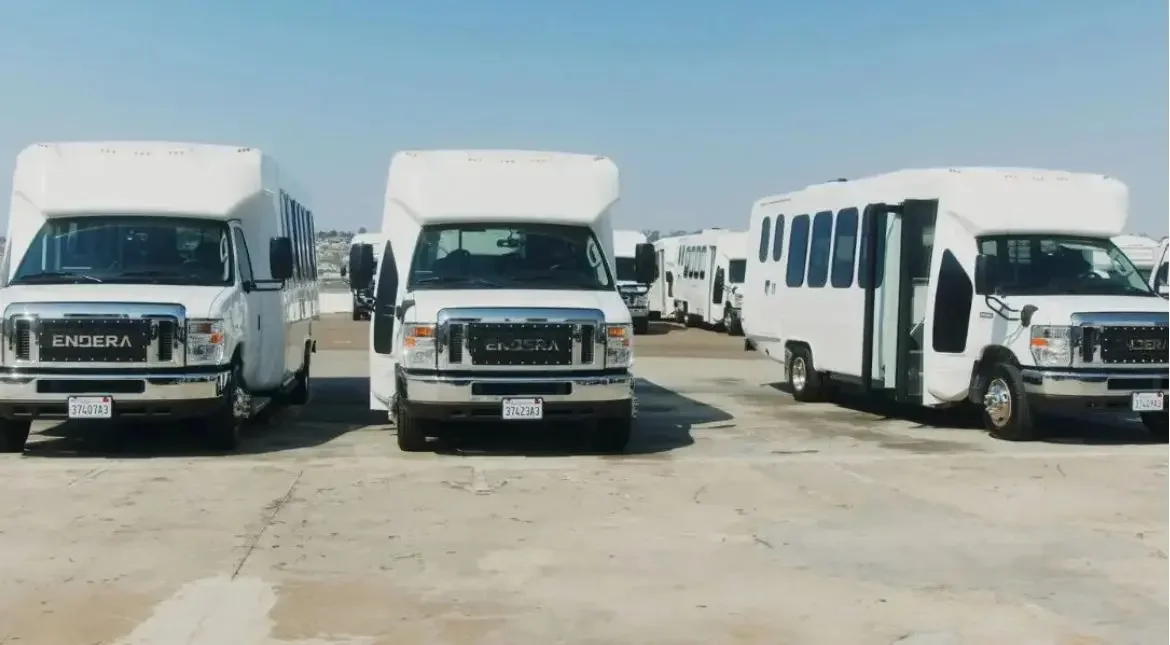
Maine's shuttle operations span coastal resorts, rural routes, and college campuses with long winters and unpredictable conditions. Generic, climate-agnostic vehicles often fall short in places like Bangor, Bar Harbor, and Portland. In remote or rural areas, especially in winter, manufacturer support becomes critical when issues arise, making long-term reliability more important than the initial purchase.
Endera builds the B-Series shuttle from the ground up — chassis integration, powertrain, body, and software — at its 250,000-square-foot facility in Ottawa, Ohio. There's no upfitter chain, no split warranty, and no ambiguity about who's responsible when something needs attention. Maine operators get a vehicle built as a complete system, not assembled from parts sourced across multiple vendors with accountability distributed across all of them.
Ready to optimize your routes? Contact Endera's fleet specialists today to design a custom configuration blueprint for your Maine operation.
The Endera B-Series Lineup for Maine Operators
A Range of Configurations for Different Operations
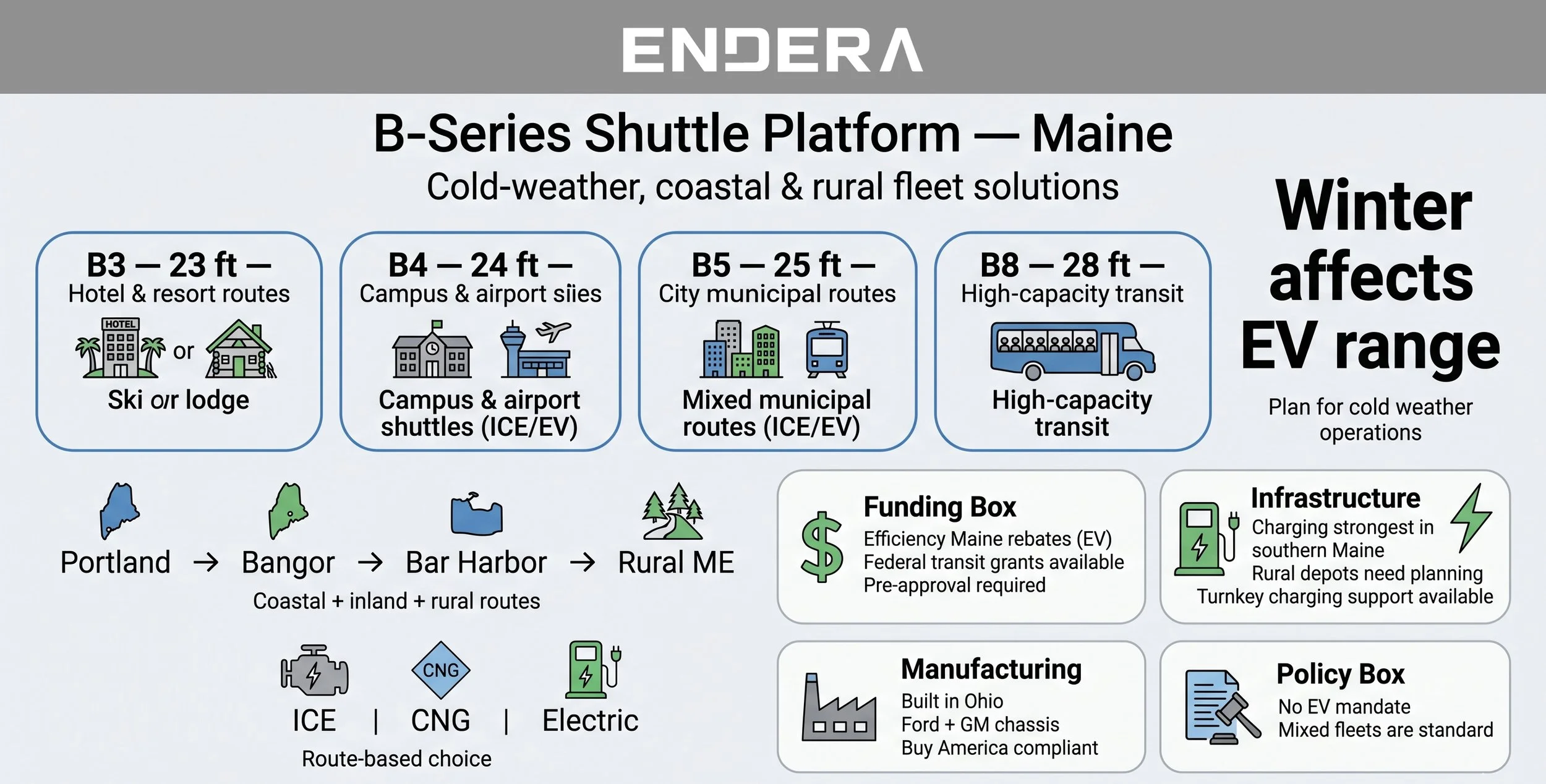
The B-Series spans 23 to 28 feet across four models, covering everything from compact hotel loops to high-capacity employee and municipal transport. Every model is built on Ford E450 or Chevrolet Express cutaway chassis — proven platforms that Maine service networks already know well, which matters when a vehicle needs attention outside of a major metro area.
The Right Model for Your Route
The B3 (23 ft) is well suited for tight urban routes and boutique hotel shuttles along the Maine coast. The B4 (24 ft) and B5 (25 ft) are available in both ICE and full-electric configurations, making them a natural fit for airport operations, university campuses, and corporate shuttles where route predictability allows for reliable overnight charging. The B8 (28 ft) handles higher-capacity municipal and group transport needs where ridership demands a larger vehicle without moving to a full transit bus platform.
ICE or Electric — Maine's Climate Shapes the Decision
Cold Weather and EV Range Are a Real Conversation
Maine winters are a legitimate operational consideration for any fleet exploring electric vehicles. Battery performance in sustained cold temperatures affects usable range, and charging infrastructure outside of southern Maine's urban centers remains limited. Maine's statewide EV charging network stood at over 600 public stations as of late 2025 — a network that continues to grow but is still concentrated along I-95 and I-295 rather than distributed across rural inland corridors. These aren't reasons to avoid electrification; they're reasons to plan it around your actual routes rather than around a manufacturer's optimistic range estimate.
How Maine Fleets Actually Operate EV Shuttles in Winter
Running electric shuttles through a Maine winter is about operating smarter around real constraints. Cold temperatures reduce usable range, driven mainly by battery chemistry changes and the energy needed to heat the cabin. Maine fleets that succeed with electrification account for this before the first January dispatch — not after it. The practical tools are straightforward: route-tiering, plug-in dwell discipline, and depot storage.
Route-Tiering Is the Foundation
The most effective approach is assigning EV shuttles to shorter, predictable winter routes — hotel loops, campus circulators, airport connectors — while keeping longer rural or variable routes on ICE vehicles. This keeps electric vehicles within reliable winter range windows without disrupting service levels across the fleet. A mixed-powertrain fleet isn't a compromise; for most Maine operators, it's the right answer given current infrastructure geography.
Plug-In Dwell Time and Depot Storage
Keeping shuttles plugged in between runs helps maintain battery temperature and reduces energy use at startup. Pre-conditioning while plugged in shifts heating load to the grid, improving cold-weather range reliability. Even indoor or covered storage improves usable energy compared to outdoor parking, making depot design an important part of EV planning in Maine.
Where ICE and CNG Still Make Sense
For inland operations, longer rural corridors, or routes that span multiple charging gaps, ICE and CNG configurations remain the practical choice for most operators today. MaineDOT's own fleet electrification work has consistently identified rural routes as the most challenging for battery-electric transition — a reality that Endera's dual-track production directly addresses. Maine operators aren't pressured into electrification before their routes and infrastructure support it.
Financing and Grant Funding for Maine Fleets
Two Programs Worth Knowing Before You Buy
Maine operators exploring electric B-Series models have access to meaningful state-level incentive programs that most manufacturers don't help them navigate. Getting the funding right before the purchase decision — not after — is the difference between capturing available money and leaving it on the table.
The first is Efficiency Maine's commercial electric van rebate program, which offers rebates of up to $12,000–$14,000 for Maine businesses and nonprofits purchasing new commercial electric cutaway or chassis cab vehicles. The program runs through September 30, 2026, requires pre-approval before purchase, and must be paired with an off-peak charger. Buyers apply directly for rebates when purchasing from the manufacturer, and Endera helps operators prepare documentation and navigate the process before purchase.
The second is the federal EPA Clean School Bus Program for operators running qualifying student or transit routes, and broader FTA Low or No Emission Vehicle grants for public and qualifying private transit operators. Maine's transit agencies have been active participants in FTA grant cycles, and Endera's team helps operators assess whether their operation structure qualifies for federal transit funding before the next application window opens.
Flexible Financing for Every Operation Type
Endera's financing options include direct vehicle financing and capital leasing. Leasing works particularly well for Maine's seasonal tourism sector, where preserving capital during off-season months matters and vehicle utilization is concentrated into a defined annual window. A resort operator running Bar Harbor shuttles from June through October has a very different cash flow profile than a year-round university fleet, and the financing structure should reflect that.
Software and Infrastructure Built In
Fleet Management From Day One
Every Endera B-Series shuttle comes available with Endera Dispatch — built in-house and integrated directly with the vehicle's hardware. Maine fleet managers get real-time vehicle tracking, route analytics, and maintenance scheduling in one platform, without needing a separate telematics vendor or a third-party integration contract. Because the software is built by the same team that built the vehicle, the data it surfaces reflects how the bus actually operates across real routes — not generic benchmarks from a platform adapted from another vehicle type.
The Passenger-Facing Side
Endera Go gives riders real-time shuttle tracking, ETA updates, and occupancy information. For Maine's hospitality and tourism operations where guest experience is central to the brand, that level of transparency is a meaningful differentiator — particularly during peak summer season when shuttle demand spikes and wait-time management directly affects guest satisfaction scores.
Charging Infrastructure for EV Buyers
For Maine operators selecting electric models, Endera provides full turnkey charging support — site assessment, charger procurement, and installation. One vendor handles both the vehicle and the charging setup, which simplifies the project significantly for operators who don't have a facilities team to manage a separate infrastructure contractor alongside a bus purchase. The turnkey approach also makes it easier to present a single capital proposal to ownership or a board, rather than a split-scope arrangement with two separate contractors.
Get Your Fleet Spec'd
From Bar Harbor's summer resort corridors to year-round campus routes in Orono, Maine shuttle operations need a vehicle built to last and a manufacturer who stands behind the whole thing. Endera's B-Series is built as a complete system — powertrain, body, software, and charging infrastructure — by one team accountable for all of it.
To explore configurations, check availability, and find out what funding your Maine operation may qualify for, contact Endera's sales team.
FAQs
Does Endera sell shuttle buses in Maine?
Yes. Endera sells new B-Series shuttle buses to fleet operators throughout Maine, including hotel and resort operations, airport shuttles, university campuses, healthcare systems, and municipal operators. The sales team can walk through available configurations, financing options, and applicable grant funding for your specific operation.
What B-Series models are available for Maine operators?
Maine buyers can choose from the B3 (23 ft, ICE), B4 (24 ft, ICE or EV), B5 (25 ft, ICE or EV), and B8 (28 ft, ICE). The right model depends on route length, ridership, and whether the operation is seasonal or year-round. See the full B-Series lineup for specs and configurations.
How do Maine winters affect electric shuttle performance?
Cold temperatures reduce battery efficiency and usable range. For Maine operators considering electric, Endera recommends an honest assessment of winter route profiles and depot charging setup before selecting a configuration — and a route-tiering plan that assigns EVs to shorter, predictable runs during cold months.
Are Endera shuttles eligible for Maine's Efficiency Maine commercial EV rebate?
Maine businesses and nonprofits purchasing new commercial electric cutaway vehicles may qualify for Efficiency Maine's commercial electric van rebate of up to $12,000–$14,000. The program requires pre-approval before purchase. Endera's team helps operators navigate the pre-approval process and documentation requirements directly.
Does Endera offer financing options for seasonal operations?
Yes. Capital leasing is available and works well for Maine's seasonal tourism operations, where preserving cash flow during off-peak months is a real priority. The financing team can walk through leasing terms alongside direct financing options.
Does Endera provide charging infrastructure for Maine EV buyers?
Yes. Endera provides full turnkey charging infrastructure — site assessment, charger procurement, and installation — as part of its EV offering. Maine operators work with one vendor for both the vehicle and the charging setup.
What software comes with an Endera shuttle bus?
Every Endera B-Series shuttle comes available with Endera Go (real-time passenger tracking and ETA) and Endera Dispatch (fleet management, routing, and vehicle health data). Both are built in-house and integrate directly with the vehicle's hardware.