
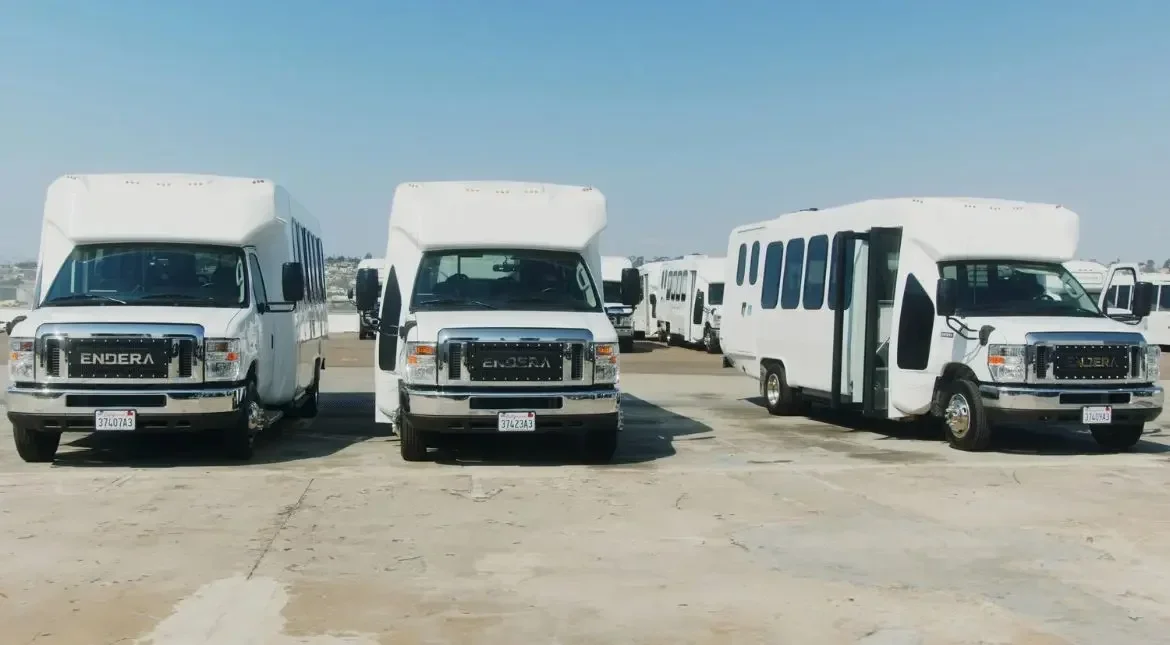
Hawaii's commercial shuttle market operates under conditions that make the ICE versus electric decision more consequential than in most mainland states. High fuel costs compress ICE operating margins on repetitive daily routes. Resort and airport circuits are short, predictable, and ideal for overnight depot charging. And the tourism industry's sustainability positioning increasingly extends to guest transportation — a quiet, zero-emission shuttle arriving at a resort entrance communicates something about the property that a diesel van does not.
Endera manufactures Class 4 B-Series commercial shuttles in ICE, propane, CNG, and full-electric configurations on Ford E450 and Chevrolet Express cutaway chassis. For Hawaii resorts, airports, tour operators, healthcare systems, and transit agencies, the B-Series delivers commercial-grade passenger transport purpose-built for the daily cycle counts that island hospitality operations demand.
Ready to spec your fleet? Contact Endera's fleet specialists today to design a custom configuration blueprint for your operation.
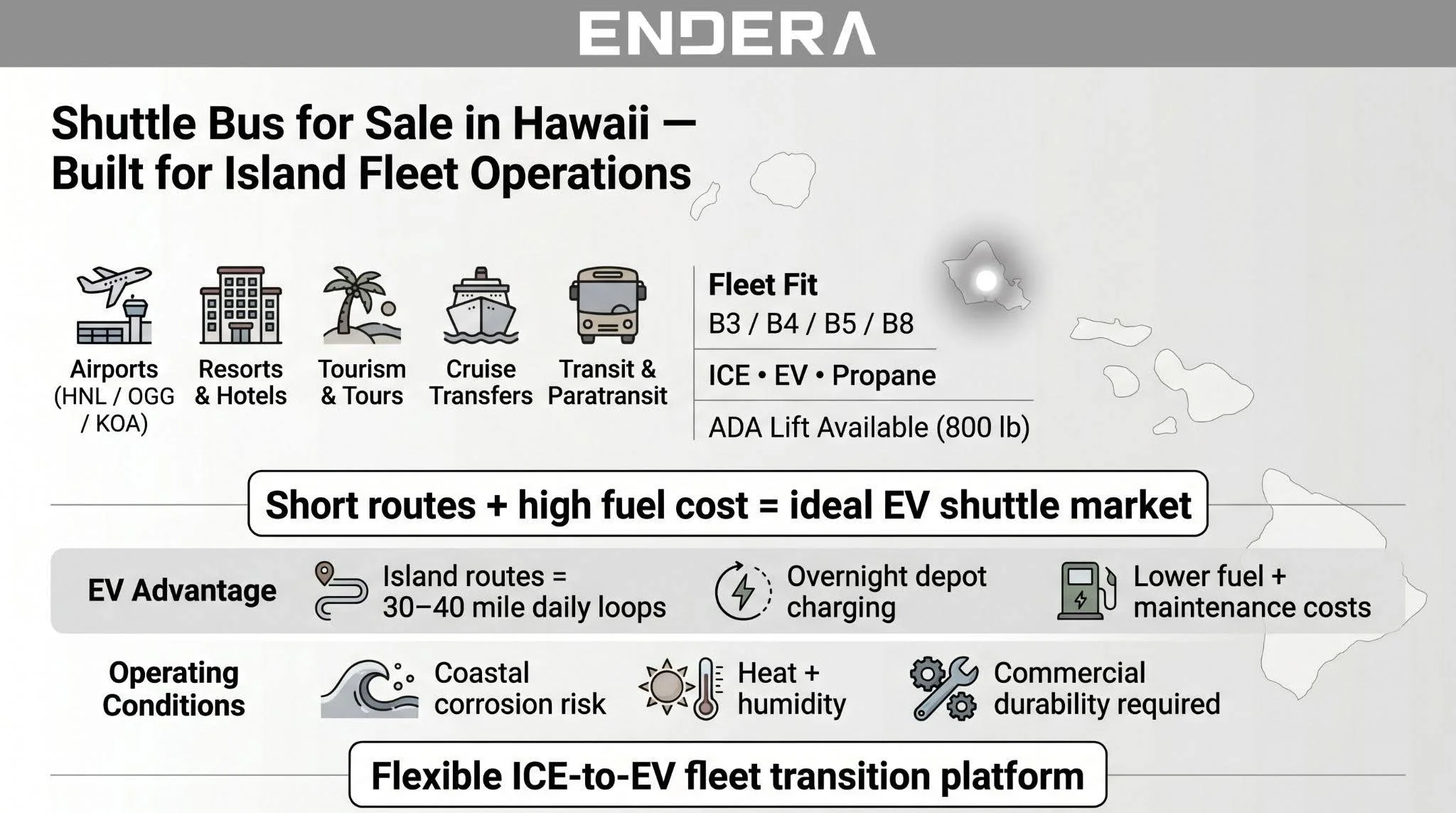
Why Hawaii's Shuttle Market Is Different
Hawaii's tourism authority visitor data reflects one of the highest visitor-to-resident ratios of any U.S. state — creating shuttle demand that is structurally elevated relative to population size. The U.S. Travel Association's travel figures and federal tourism transportation planning resources both document how shuttle connectivity shapes visitor experience in tourism-dependent markets — a dynamic that is more pronounced in Hawaii than almost anywhere else in the country.
BLS Hawaii workforce statistics reflect the hospitality-heavy employment profile that also drives employee shuttle demand — hotels, resorts, and tourism operators all run worker transportation programs alongside guest-facing fleets.
Island Route Characteristics and EV Fit
Hawaii's island geography creates natural EV operating conditions. Routes are short and self-contained — airport loops, resort circuits, and between-property shuttles rarely exceed 30 to 40 miles of daily mileage. Overnight depot charging is straightforward. Hawaii's state EV initiative and Hawaiian Electric's clean transportation infrastructure support the charging infrastructure that makes electric fleet operation practical across Oahu, Maui, and the Big Island.
ICE vs. Electric: The Hawaii Fleet Decision
The economic case for electric is stronger in Hawaii than in most states. Gasoline prices in Hawaii consistently run 50–80 cents per gallon above mainland averages — a differential that makes per-mile fuel cost reduction from electric drivetrains more impactful on operational economics.
Combined with lower maintenance spend (30–40% less than diesel per DOE vehicle efficiency data) and the EPA's green vehicle emissions benefits, the total cost of ownership case for electric is compelling on Hawaii's high-cycle resort and airport routes.
When ICE Remains the Right Call
Remote areas on the Big Island, inter-facility routes with high daily mileage, or operations without existing depot charging should consider ICE or propane as the current-cycle solution. Hawaii's charging infrastructure is expanding but is not yet uniformly available across all islands. All B-Series configurations share the same platform — standardizing on Endera now doesn't foreclose an EV transition on the next procurement cycle.
Hawaii Shuttle Use Cases: Where the B-Series Fits
Hawaii's shuttle demand spans several distinct operational profiles across the islands.
Resorts, Hotels, and Tourism Transportation
The resort corridor from Waikiki to Wailea to the Kohala Coast generates some of the highest hospitality shuttle cycle counts in the country. Airport pickup, between-property guest transport, and resort amenity circuits all require vehicles with commercial durability, luggage accommodation, and the passenger comfort that premium hospitality settings demand.
The UNWTO sustainable development framework connects eco-friendly transportation to modern resort guest expectations — a positioning that electric B4 and B5 models support directly.
Airport Shuttle Operations
Honolulu's Daniel K. Inouye International Airport, Kahului Airport in Maui, and Kona International Airport all support hotel and parking shuttle operations. BTS 2024 airline passenger traffic data reflects sustained visitor volume driving airport ground transportation demand. Airport ground transportation planning guidance outlines the operational requirements — fixed-route efficiency, luggage accommodation, and high passenger turnover — that the B4's configuration handles well.
Tour Operators and Cruise Transportation
Hawaii's tour operator market runs group excursion transport, cruise terminal transfers, and inter-attraction circuits that require higher-capacity vehicles and reliable scheduling. The B5 and B8 handle these applications well — enough passenger capacity to keep per-trip costs manageable and the commercial build quality to sustain the daily cycle intensity of peak tourism season.
Coastal Climate and Fleet Durability
Hawaii's salt air, humidity, and year-round heat create operating conditions that accelerate corrosion and wear on vehicles not built to commercial specifications. Resort and airport shuttle operations that run 10 to 15 daily cycles in coastal environments compress the service timeline of light-duty van conversions significantly faster than equivalent mainland operations.
The B-Series is built on medium-duty Ford E450 and Chevrolet Express cutaway chassis — commercial platforms with structural durability ratings and parts availability suited to Hawaii's operating conditions. Hawaii DOT highway infrastructure resources and the Honolulu Department of Transportation Services reflect the transportation investment framework within which Hawaii fleet operators procure and maintain commercial vehicles.
Maintenance Access Across the Islands
Parts availability and technician familiarity are practical procurement considerations for Hawaii operators — particularly on neighbor islands where specialized service infrastructure may be limited. Ford E450 and Chevrolet Express cutaway chassis have broad national service networks, reducing the risk of extended downtime on islands where alternative service options are scarce.
ADA Accessibility for Hawaii Hospitality and Transit Fleets
Hawaii transit agencies and hospitality operators must meet ADA accessible transportation requirements and FTA Part 37 regulations. ADA vehicle accessibility design guidance defines the engineering standards that accessible shuttle configurations must meet. Honolulu's Handi-Van paratransit program reflects the scale of accessible transportation demand in Hawaii's largest city.
Endera's flat-floor B-Series configurations include 800 lb Braun ADA lifts installed at the manufacturing stage. For Hawaii healthcare operators, senior living communities, and resort properties serving guests with mobility needs, OEM-installed equipment provides unified warranty coverage and cleaner compliance documentation than post-sale retrofits.
The B-Series Lineup for Hawaii Fleets
| Model | Length | Fuel Options | Best Fit |
|---|---|---|---|
| B3 | 23 ft | ICE | Boutique resort loops, community transport |
| B4 | 24 ft | ICE & EV | Airport shuttles, resort circuits, hotel transport |
| B5 | 25 ft | ICE & EV | Tour groups, cruise terminals, employee transport |
| B8 | 28 ft | ICE | High-volume convention, group, event transport |
Ready to Spec a Shuttle for Your Hawaii Fleet?
Several 2026 B-Series units are available for immediate delivery through Endera Stock, including ADA-configured flat-floor models and standard passenger layouts. For operators working within formal procurement or grant-aligned purchasing cycles, Endera provides full specification documentation and financing support.
Contact Endera's fleet specialists to discuss fleet configuration, EV range estimates for your Hawaii routes, or fleet pricing.
Frequently Asked Questions
Are electric shuttle buses more cost-effective in Hawaii than on the mainland?
Yes — Hawaii's fuel prices consistently run 50–80 cents per gallon above mainland averages, which makes the per-mile fuel cost reduction from electric drivetrains more impactful on operational economics. Combined with lower maintenance costs and Hawaii's expanding EV charging infrastructure, the total cost of ownership case for electric is stronger in Hawaii than in most other states.
What shuttle configuration works best for Hawaii resort and airport operations?
The B4 (24 ft) handles most Hawaii resort circuits and airport hotel loops efficiently — fixed routes, predictable daily mileage, and overnight depot charging that suits electric operation well. For tour groups, cruise terminal transfers, and higher-capacity convention properties, the B5 or B8 provides the passenger capacity the B4 can't match.
How does Hawaii's coastal climate affect shuttle bus selection?
Salt air, humidity, and year-round heat accelerate corrosion and wear on light-duty van conversions faster than equivalent mainland operations. The B-Series is built on medium-duty Ford E450 and Chevrolet Express cutaway chassis with commercial structural durability ratings. Ford and GM commercial service networks provide parts access across the islands, reducing downtime risk in areas where specialized service infrastructure is limited.
Are ADA-accessible shuttle buses available for Hawaii hospitality and transit operators?
Yes. Flat-floor B-Series configurations include 800 lb Braun ADA lifts installed at the manufacturing stage, meeting FTA Part 37 requirements. For Hawaii resort properties serving guests with mobility needs, healthcare operators, and transit agencies running paratransit services, OEM-installed equipment provides unified warranty coverage and cleaner compliance documentation than aftermarket modifications.
What is the EV range of the B-Series electric shuttle and does it suit Hawaii routes?
The B-Series electric models use a 150 kWh battery pack with DC fast charging standard. Hawaii's island route profiles — typically 30 to 40 miles of daily mileage on resort and airport circuits — fall well within operational range even accounting for climate-related battery variation. Endera provides route-specific range estimates during the sales process based on actual daily mileage and cycle counts.
Do B-Series shuttle buses require a CDL in Hawaii?
Most B-Series configurations fall below the federal CDL threshold — under 26,001 lbs GVWR and fewer than 16 passengers including the driver. Hawaii operators running for-hire commercial transport should confirm state-specific licensing requirements, as for-hire passenger carrier rules may add licensing layers beyond the standard federal CDL threshold.
Can B-Series shuttles be customized for Hawaii resort branding?
Yes. B-Series exteriors support custom wraps, logo placement, and fleet color matching for properties that want shuttle vehicles to reflect their brand identity. Interior configurations — seating layout, luggage storage, and climate control specifications — are finalized during the order process to match the property's operational requirements.