
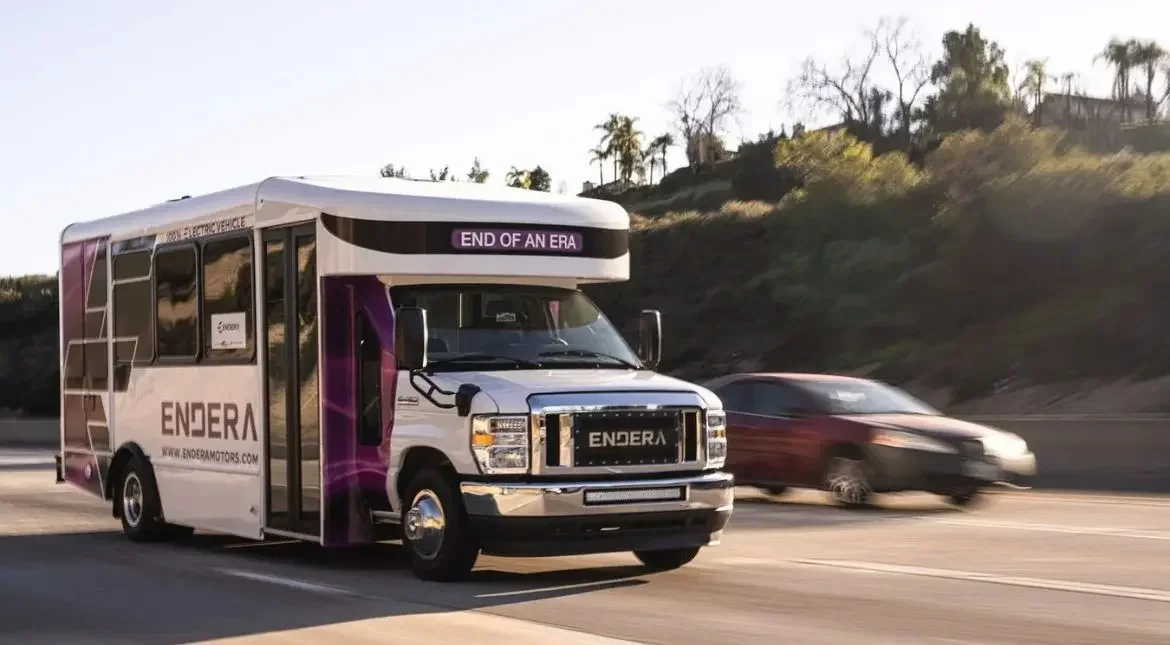
For many commercial shuttle operators, the CDL requirement isn't a minor inconvenience — it's a real constraint on hiring speed, labor cost, and operational flexibility. A hotel running an airport shuttle, a church transporting members, or a senior living community moving residents to appointments can't always wait for CDL candidates, and the ongoing commercial driver shortage has made that constraint more acute over the past several years.
Endera's B-Series commercial shuttles are built on Ford E450 and Chevrolet Express cutaway chassis with a 14,500 lb GVWR — keeping most configurations below the federal CDL threshold. For fleet operators who need commercial-grade vehicles without the staffing complexity of CDL hiring, the B-Series delivers purpose-built shuttle performance with a much wider driver pool. Endera's B-Series lineup spans the B3, B4, and B5 in 23–25 foot configurations, with ICE and full-electric powertrains available, ADA-accessible flat-floor models, and route-specific customization handled at the factory level.
Ready to spec your fleet? Contact Endera's fleet specialists today to design a custom configuration blueprint for your operation.
What Makes a Shuttle Bus Non-CDL?
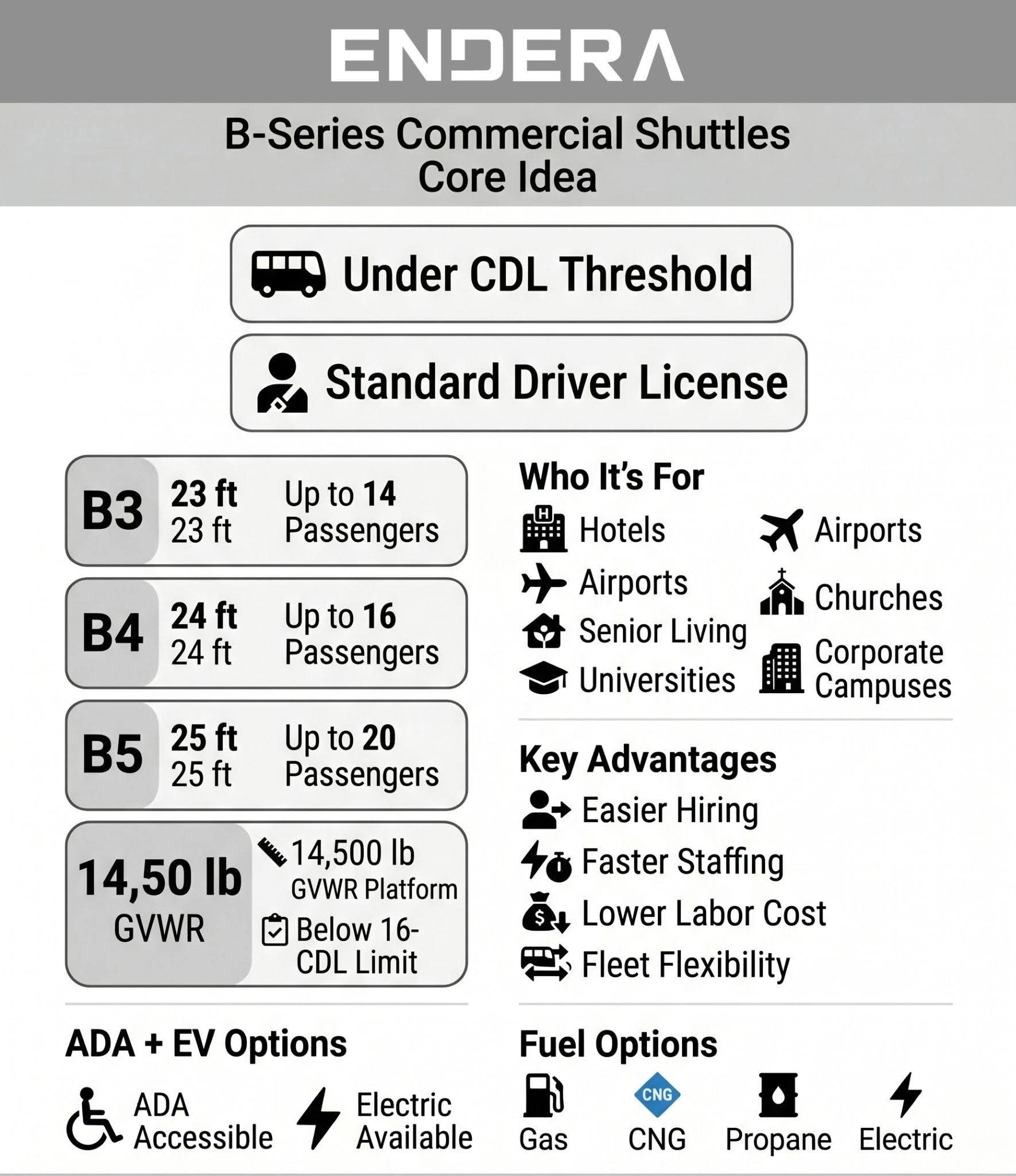
Under federal FMCSA commercial driver's license regulations, a CDL is required to operate a commercial motor vehicle with a GVWR over 26,001 lbs, or a vehicle designed to transport 16 or more passengers including the driver. Most B-Series configurations fall below both thresholds — which means operators in most states can run these vehicles with standard driver's licenses.
The FMCSA guidance on vehicles under 26,001 lb GVWR outlines the specific weight and classification rules that determine CDL applicability. Understanding the threshold — not just the label — is what allows operators to structure their fleets and hiring programs correctly.
What "Non-CDL" Does Not Mean
Non-CDL does not mean unregulated. The FMCSA's distinction between commercial motor vehicles and non-CMVs is important: even without a CDL requirement, drivers operating commercially may still need DOT medical cards, driver qualification files, and compliance with hours-of-service rules depending on route structure and compensation model.
FMCSA passenger carrier guidance provides the full framework for passenger transportation operations — including when a passenger endorsement is required and when interstate commerce rules apply. The FMCSA multi-modal passenger transportation guidance adds further nuance for airport and hospitality shuttle operators specifically. Operators should review applicable federal and state rules for their specific route type and compensation model before finalizing fleet configuration.
Why GVWR Matters for Commercial Shuttle Operators
The B-Series is built on Ford E450 and Chevrolet Express cutaway chassis with a 14,500 lb GVWR — well below the 26,001 lb federal CDL threshold. That weight classification is the structural reason most B-Series configurations remain non-CDL eligible, and it's determined by the chassis and body combination, not passenger count alone.
ADA-configured flat-floor models with wheelchair lifts add weight, and seating configurations affect total loaded weight. Operators should confirm final vehicle specifications against applicable state weight and passenger thresholds — particularly for for-hire operations where state licensing requirements may layer on top of federal CDL rules. Endera's sales team provides full specification documentation to support that review.
The Staffing Case for Non-CDL Shuttle Fleets
The commercial driver shortage has made CDL hiring a genuine operational constraint for many fleet operators. Non-CDL shuttle operations draw from a significantly larger candidate pool — standard license holders who can be onboarded faster, at lower training cost, and without the CDL premium that commercial drivers command in a tight labor market.
For hotels, churches, senior living communities, and healthcare transport programs, this matters in practical scheduling terms. When a CDL driver calls out, replacing the shift from a CDL candidate pool is often difficult. When the vehicle doesn't require a CDL, coverage is more manageable — a meaningful operational difference that compounds over time for fleets running daily multi-shift schedules. Even non-CDL operations may require DOT driver qualification compliance depending on operational classification, so operators should confirm applicable requirements for their specific use case.
The B-Series Lineup: Non-CDL Configurations
| Model | Length | GVWR | Fuel Options | Header 5 |
|---|---|---|---|---|
| B3 B4 B5 |
23 ft 24 ft 25 ft |
14,500 lbs 14,500 lbs 14,500 lbs |
ICE ICE & EV ICE & EV |
Up to 14 passengers Up to 16 passengers Up to 20 passengers |
Passenger counts vary by seating layout and ADA configuration. ADA flat-floor models with wheelchair positions reduce ambulatory seating. Total passenger count — including the driver — relative to the 16-passenger CDL threshold should be confirmed for each configuration before operational deployment.
Who Uses Non-CDL Shuttle Buses
Non-CDL shuttle fleets serve a wide range of commercial and institutional operators:
Hotels and resorts — property-to-airport loops, valet shuttles, and guest transport where staffing flexibility is a daily operational need
Airport parking operators — high-frequency lot-to-terminal runs where shift coverage and driver availability matter
Churches and religious organizations — Sunday service and event transport, typically relying on volunteer or part-time drivers
Senior living and assisted living — resident transport for appointments and activities, often requiring ADA-configured vehicles and accessible boarding
Universities and private schools — campus and off-campus transport, sometimes staffed by student employees or part-time drivers
Healthcare providers — non-emergency patient transport and staff shuttle operations
Corporate campuses — employee circulator routes where CDL hiring would add unnecessary cost and lead time
For each of these buyer types, the non-CDL advantage is not just about licensing — it's about operational flexibility, scheduling resilience, and the ability to scale a fleet without being constrained by a specialist labor market.
ADA-Accessible Non-CDL Shuttle Options
ADA accessibility and non-CDL eligibility are not mutually exclusive. Endera's flat-floor B-Series configurations include 800 lb Braun ADA lifts installed at the manufacturing stage — meeting ADA accessible transportation requirements and FTA Part 37 transportation service regulations as delivered.
For senior living communities, healthcare transport operators, and any fleet serving passengers with mobility needs, the National Aging and Disability Transportation Center provides resources on accessible community transportation planning and compliance. ADA-configured B-Series models remain within the 14,500 lb GVWR range — operators should confirm final configuration weights and passenger counts against applicable non-CDL thresholds during the specification process.
Electric Non-CDL Shuttle Options
The B4 and B5 are available in full-electric configurations with a 150 kWh battery pack and DC fast charging standard on every unit. Electric non-CDL shuttles offer the same driver pool advantages as ICE models, with lower fuel and maintenance costs that compound over a 10-to-12-year service life.
For hotel, airport, and senior living operators running fixed daily routes with overnight depot charging, the electric B4 reduces per-mile operating cost while eliminating tailpipe emissions at the point of operation. Endera's turnkey charging platform handles site assessments, charger procurement, and metering installation — removing the infrastructure planning step from operators who want to deploy electric without building that capability in-house.
Build Your Non-CDL Commercial Shuttle Fleet
Several 2026 B-Series units are available for immediate delivery through Endera Stock, including ADA-configured flat-floor models and standard passenger layouts. For operators working through fleet specification, licensing review, or financing, Endera's sales team provides configuration documentation and compliance materials to support the purchasing process.
Contact Endera's fleet specialists to discuss non-CDL shuttle configurations, powertrain options, or fleet financing.
Frequently Asked Questions
What qualifies a shuttle bus as non-CDL?
Under federal FMCSA rules, a CDL is required for vehicles with a GVWR over 26,001 lbs or those designed for 16 or more passengers, including the driver. Most B-Series configurations have a 14,500 lb GVWR and seat fewer than 16 passengers — keeping them below both thresholds in most operating contexts. State rules and for-hire commercial transport regulations may add requirements beyond the federal CDL threshold, so operators should confirm applicable rules for their specific route and compensation model.
Does "non-CDL" mean no regulations apply?
No. Non-CDL does not mean unregulated. Depending on operational classification, drivers may still need DOT medical cards, driver qualification files, and compliance with applicable FMCSA passenger carrier rules — even without a CDL. Interstate commercial operations, for-hire transport, and operations crossing certain passenger thresholds all carry specific compliance requirements that operators should review with their legal or compliance team.
How many passengers can a non-CDL shuttle bus carry?
The federal CDL threshold for passenger vehicles is 16 or more passengers including the driver. Most B-Series configurations seat 10 to 14 passengers plus the driver — staying below that threshold. ADA configurations with wheelchair positions reduce ambulatory seating, which can affect total count. Operators should confirm actual seating configurations and total passenger count against the 16-passenger threshold before deployment.
Are ADA-accessible shuttle buses available in non-CDL configurations?
Yes. Endera's flat-floor B-Series configurations include 800 lb Braun ADA lifts installed at the manufacturing stage, and the 14,500 lb GVWR remains within non-CDL weight limits. ADA-configured models are appropriate for senior living, healthcare, and paratransit applications where accessible boarding is required. Final configuration weights and passenger counts should be confirmed during the specification process.
Are there electric non-CDL shuttle buses available?
Yes. The B4 and B5 are available in full-electric configurations on the same 14,500 lb GVWR platform. Electric models include a 150 kWh battery pack with DC fast charging standard. For hotel, airport, and campus operators running fixed daily routes, electric non-CDL shuttles reduce per-mile operating cost while maintaining the driver pool advantages of non-CDL weight classification.
Why do many commercial fleet operators prefer non-CDL shuttles?
The commercial driver shortage has made CDL hiring a real operational constraint for many fleet operators. Non-CDL fleets draw from a substantially larger candidate pool — standard license holders who can be recruited, onboarded, and scheduled more flexibly than CDL-only candidates. For hotels, churches, senior living communities, and healthcare operators running daily shuttle services, that staffing flexibility has practical day-to-day value that goes beyond the licensing question itself.
What industries benefit most from non-CDL shuttle fleets?
Hotels and resorts, airport parking operators, churches, senior living communities, universities, healthcare providers, and corporate campus operators all benefit from non-CDL shuttle configurations. The common thread is organizations that need reliable daily passenger transport but can't or don't want to build their staffing model around a CDL-licensed driver pool. For these operators, non-CDL eligibility is an operational strategy, not just a compliance detail.