
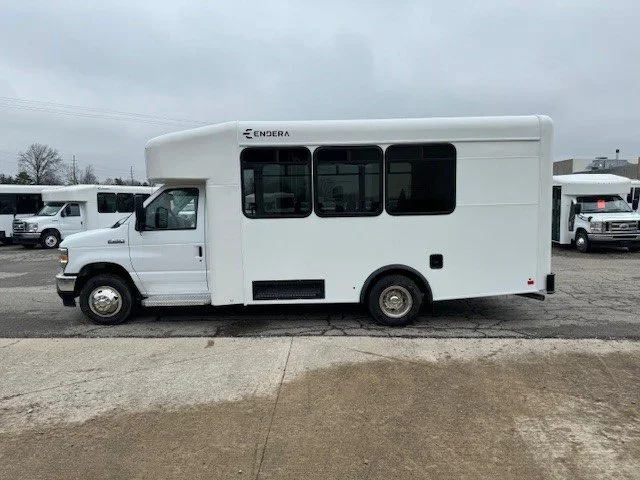
New Hampshire's shuttle market varies by region: seasonal resort loops in the White Mountains, year-round hotel and healthcare routes in the Seacoast, and structured campus transit at UNH, Dartmouth, and Plymouth State. Despite different use cases, all operators need reliable vehicles that perform consistently in harsh weather without causing downtime or maintenance issues.
Endera builds the B-Series shuttle from the ground up — chassis integration, powertrain, body, and software — at its 250,000-square-foot facility in Ottawa, Ohio. No upfitter chain, no split warranty, and no situation where one vendor points at another when something needs attention. For New Hampshire operators evaluating a new shuttle or fleet refresh, Endera's B-Series lineup spans the B3, B4, B5, and B8 in 23–28 foot configurations, with ICE and full-electric powertrains available and route-specific customization handled at the factory level.
Ready to spec your fleet? Contact Endera's fleet specialists today to design a custom configuration blueprint for your operation.
The Endera B-Series Lineup for New Hampshire Operators
Four Models Built for Different Operations
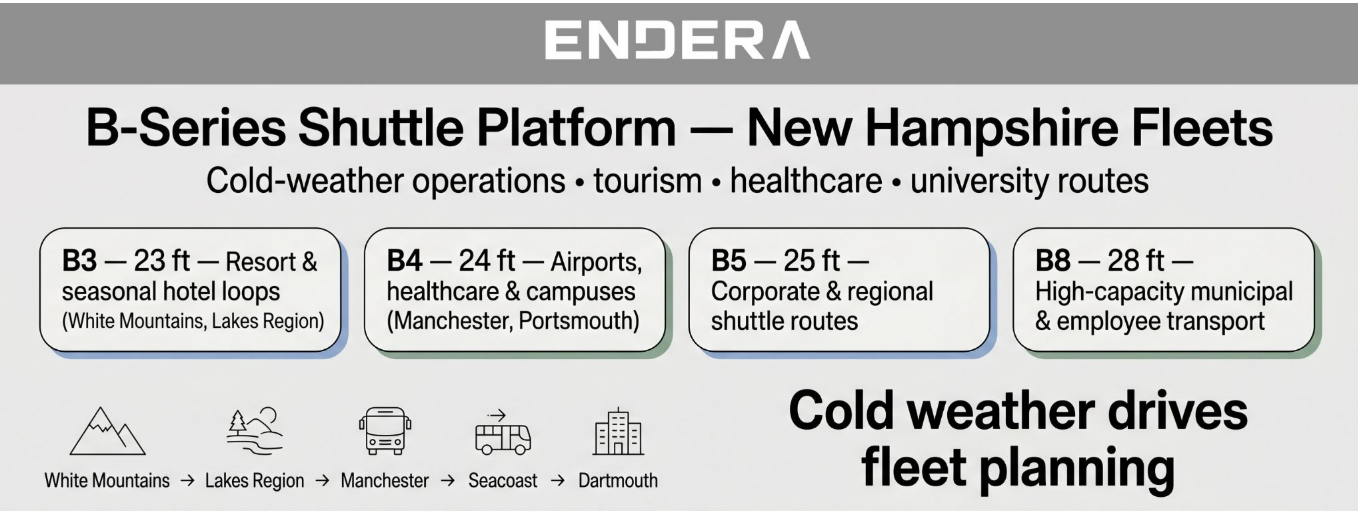
The B-Series spans 23 to 28 feet across four models, covering everything from compact inn and boutique hotel loops in the Lakes Region to higher-capacity employee and healthcare campus shuttles in Manchester and Concord. Every model is built on Ford E450 or Chevrolet Express cutaway chassis — platforms that New England service networks already support, which matters when a vehicle needs attention between runs rather than during a scheduled service window.
Matching the Model to the Route
The B3 (23 ft) handles compact routes and smaller hotel operations where maneuverability in tight drop-off areas matters more than raw capacity. The B4 (24 ft) and B5 (25 ft) are available in both ICE and full-electric configurations, making them well suited for Manchester-Boston Regional Airport ground transport, university campus circulators, and corporate fleet operations across the southern tier of the state. The B8 (28 ft) covers higher-capacity needs — employee shuttles at larger healthcare systems, municipal transport, or group operations in peak season — without requiring a full transit bus platform.
ICE or Electric — What New Hampshire Operators Need to Know
Cold Weather Is a Real Operational Factor
New Hampshire winters are genuinely cold, and that matters for EV planning in a way it doesn't in Tennessee or Florida. Battery range narrows in sustained cold temperatures due to battery chemistry changes and the energy draw required for cabin heating. That's not a reason to avoid electric vehicles — it's a reason to plan EV deployment around routes that the cold won't disrupt, and keep ICE vehicles on the runs where range variability would create real service problems.
Where Electric Works in New Hampshire
For depot-based routes with predictable mileage and overnight charging access, the B4 and B5 electric models are a solid operational fit even in a New Hampshire winter. Manchester airport hotel loops, university campus circulators, and Seacoast healthcare shuttles with structured scheduling and centralized parking are the right starting point for electrification. The Alternative Fuels Data Center tracks active New Hampshire programs supporting fleet electrification, including NHDES-administered DERA funding available to private transit companies and fleet operators for projects that reduce diesel emissions — covering vehicle purchases, conversions to alternative fuels, and infrastructure. Operators on the right routes shouldn't assume EV adoption requires waiting for the state to develop more infrastructure.
Where ICE and CNG Still Make Sense
For rural routes in Carroll, Grafton, and Coos Counties, longer mountain corridors and areas without reliable charging, ICE and CNG remain the most practical option. Northern New Hampshire's charging infrastructure is still developing, so operators shouldn't rely on it yet. Endera's dual-track production allows fleets to mix powertrains — electric where viable and ICE where needed.
Pre-Conditioning and Depot Discipline Matter
For New Hampshire EV operators, key winter practices include keeping vehicles plugged in between runs, pre-conditioning while connected to grid power, and storing vehicles in garages when possible to preserve range. These simple steps improve cold-weather performance, but they need to be built into operations from the start rather than addressed after issues arise.
Which B-Series Model Fits Your New Hampshire Route?
Manchester, Concord, and the Southern Tier
New Hampshire's southern tier has the highest concentration of shuttle demand, including Manchester-Boston Regional Airport, healthcare systems like Elliot Health System and Catholic Medical Center, and corporate routes along the Route 3 and I-293 corridor. The B4 and B5 are well suited for these predictable, depot-charged operations, with electric options fitting airport, hotel, and healthcare shuttle use cases.
The White Mountains and North Country
Seasonal resort shuttle demand in North Conway, Bretton Woods, Franconia, and the White Mountains is driven by peak winter and summer tourism, with sharp off-season dips. The B3 and B4 fit most resort routes, while ICE is better for longer or inter-resort corridors. Endera's capital leasing option can also help align costs with seasonal utilization.
Lakes Region and Seacoast
Lake Winnipesaukee resorts, Wolfeboro and Meredith hotel shuttles, and Seacoast operators in Portsmouth and Hampton run shorter, more consistent, longer-season routes than the mountain market. The B4 is typically the best fit. Portsmouth's healthcare corridor, including Portsmouth Regional Hospital, also supports structured shuttle demand that works well with fleet management software due to predictable routes and schedules.
University and Healthcare Campuses
UNH, Dartmouth, Plymouth State, and Keene State all generate structured campus shuttle demand that supports EV deployment even in cold climates. Dartmouth-Hitchcock Medical Center also operates a large healthcare transport network across rural northern New England. For mixed-use fleets, Endera enables operators to run EVs on campus routes and ICE on longer rural trips within a single platform and vendor relationship.
Software and Infrastructure Built In
Fleet Management Without the Added Complexity
Every Endera B-Series shuttle comes available with Endera Dispatch — built in-house and integrated directly with the vehicle's hardware. New Hampshire fleet managers get real-time vehicle tracking, route analytics, and maintenance scheduling in one platform without needing a separate telematics contract or third-party integration. Because the software is developed by the same team that built the vehicle, the data it surfaces reflects how the bus actually operates across real routes — not adapted benchmarks from a platform designed for a different vehicle class.
The Passenger-Facing Side
Endera Go gives riders real-time shuttle tracking and ETA updates. For hospitality operations where guests are navigating an unfamiliar resort or hotel campus, that visibility reduces wait-time anxiety and improves the ground experience in a way that a dispatcher calling out arrival times manually never fully replicates. For healthcare operations where patients are managing appointments and transport connections, the same visibility serves a different but equally practical function.
Charging Infrastructure for EV Buyers
For New Hampshire operators selecting electric models, Endera provides full turnkey charging support — site assessment, charger procurement, and installation. One vendor for the vehicle and the charging setup means no split scope, no separate infrastructure contractor to manage, and no ambiguity about who's responsible when a charger needs attention. For operators presenting an EV deployment to a board or ownership group, a single turnkey capital proposal is a cleaner task than a two-vendor arrangement with independent timelines and scopes.
New Hampshire Operations Need a Vehicle Built for New England
From the White Mountains to the Seacoast, New Hampshire shuttle operations run across terrain, weather, and seasonal patterns that a generic shuttle manufacturer doesn't plan around. Endera's B-Series is built as a complete system — powertrain, body, software, and charging infrastructure — by one team accountable for all of it. For operators who have dealt with the split-vendor problem before, that accountability is worth more than it sounds on a spec sheet.
Contact Endera's fleet specialists to explore configurations, check current availability, and find out what funding your New Hampshire operation may qualify for.
FAQs
Does Endera sell shuttle buses in New Hampshire?
Yes. Endera sells new B-Series shuttle buses to fleet operators throughout New Hampshire, including airport ground transport, resort and hotel operations, healthcare campuses, university fleets, and municipal operators. The sales team can walk through configurations, financing, and applicable grant funding for your specific operation.
What B-Series models are available for New Hampshire operators?
New Hampshire buyers can choose from the B3 (23 ft, ICE), B4 (24 ft, ICE or EV), B5 (25 ft, ICE or EV), and B8 (28 ft, ICE). The right model depends on route length, ridership volume, seasonal patterns, and depot infrastructure.
How do New Hampshire winters affect electric shuttle performance?
Cold temperatures reduce usable range through battery chemistry changes and cabin heating demands. For New Hampshire EV operators, route-tiering — assigning EVs to shorter, predictable routes — and plug-in dwell discipline are the practical tools for managing winter performance. Endera recommends an honest assessment of winter route profiles before selecting a configuration.
Are Endera shuttles eligible for NHDES DERA grant funding?
Private transit companies and fleet operators are explicitly eligible for NHDES DERA grant funding for projects that reduce diesel emissions, including vehicle replacement with electric or alternative-fuel models. Endera's team helps operators identify whether their operation qualifies and supports the application process directly.
Does Endera offer financing for seasonal operations?
Yes. Capital leasing is available and works well for New Hampshire's seasonal tourism operators, where preserving cash flow during off-peak months is a real operational priority. The sales team works through the right financing structure for each operation rather than defaulting to one approach.
Does Endera provide charging infrastructure for New Hampshire EV buyers?
Yes. Endera provides full turnkey charging infrastructure — site assessment, charger procurement, and installation — as part of its EV offering. New Hampshire operators work with one vendor for both the vehicle and the charging setup.
What software comes with an Endera shuttle bus?
Every Endera B-Series shuttle comes available with Endera Go (real-time passenger tracking and ETA) and Endera Dispatch (fleet management, routing, and vehicle health data), both built in-house and integrated directly with the vehicle's hardware.