
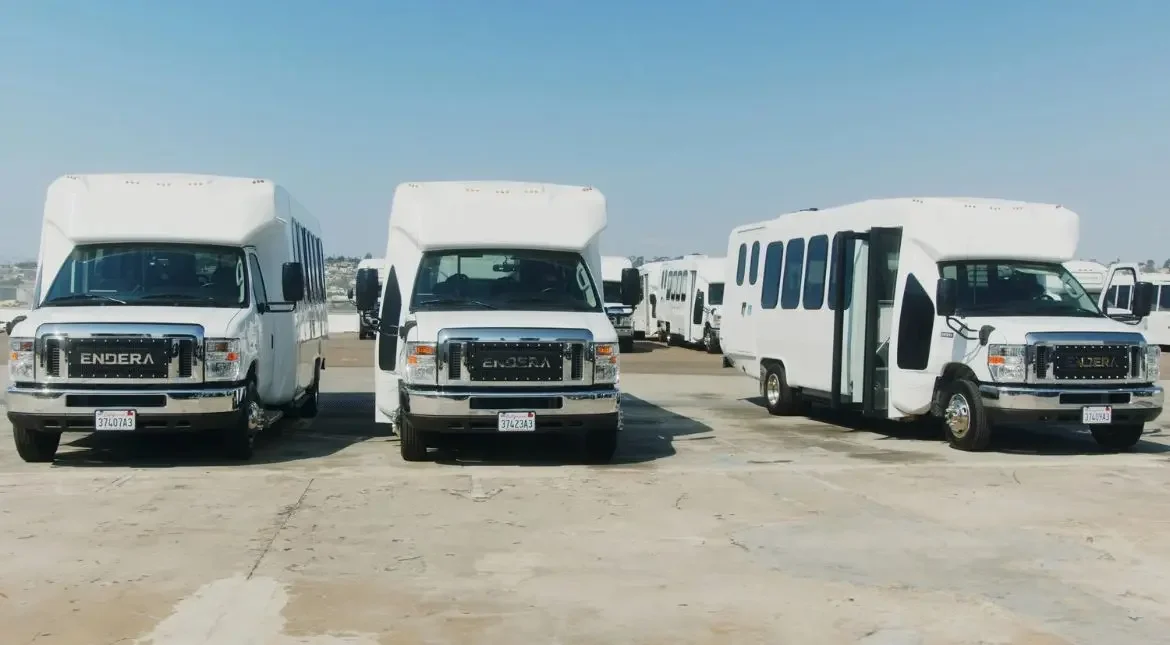
Louisiana's shuttle market spans tourism in New Orleans, universities and medical centers in Baton Rouge, Gulf Coast energy sites, and casino and resort routes. Each has different needs and route profiles, with no strong state mandates or major incentives driving EV adoption.
Endera's B-Series — the B3, B4, B5, and B8, ranging from 23 to 28 feet — is built for exactly this kind of varied landscape. ICE, propane, CNG, and full electric configurations are available on Ford E450 and Chevrolet Express cutaway chassis, manufactured at Endera's Ottawa, Ohio facility. For Louisiana operators, the multi-fuel flexibility isn't a sales feature — it's the operational reality of running shuttles in a state where the infrastructure picture varies significantly by location.
No matter where your routes run, there's a B-Series configuration that fits — talk to an Endera specialist today to find it.
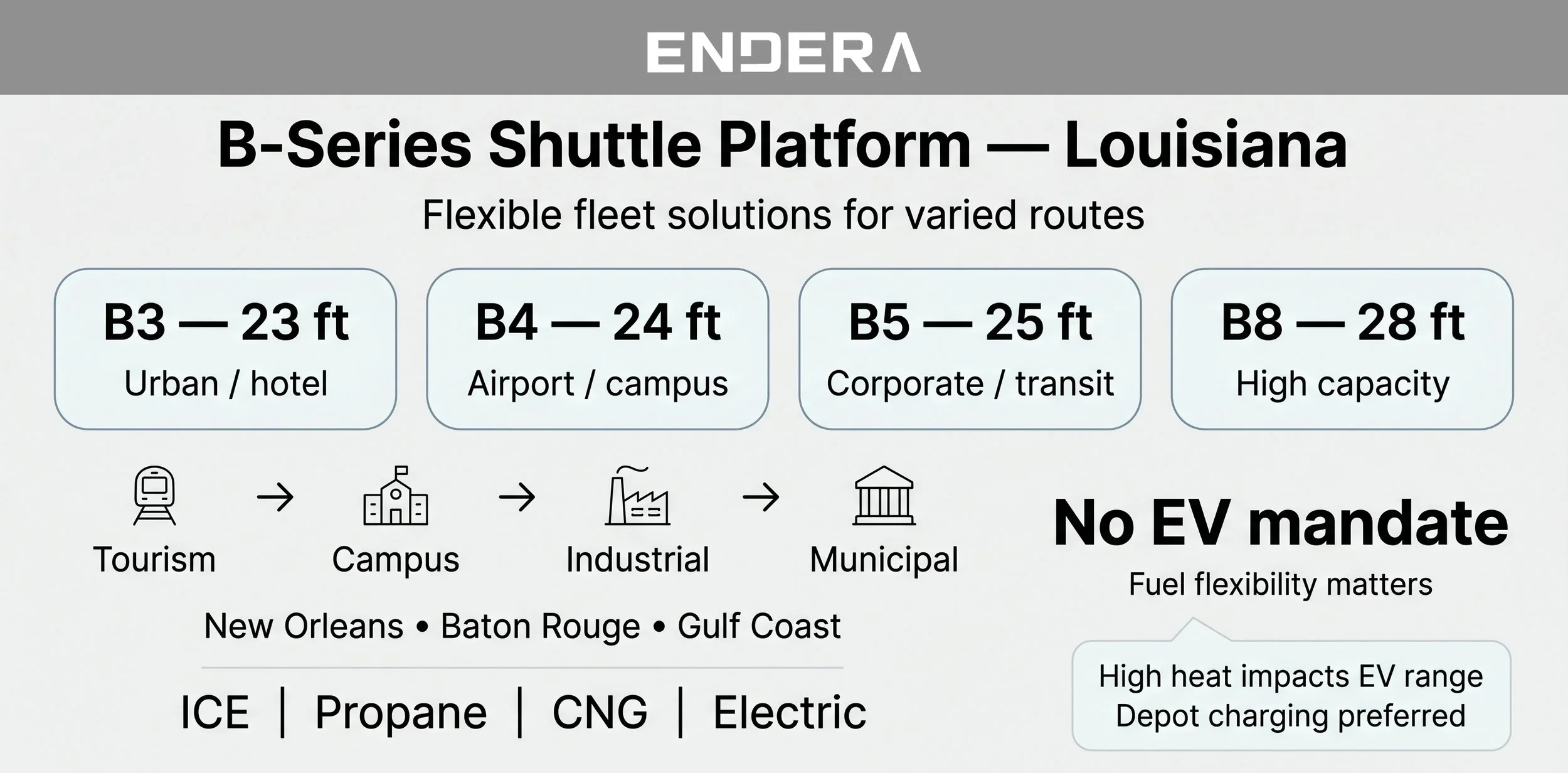
Louisiana's Fleet Landscape: No Mandate, Real Operating Demands
Where Louisiana Stands on EV Policy
Louisiana has no statewide EV mandates or vehicle purchase rebates for fleets. Incentives come mainly from utilities like Entergy, Cleco, and SWEPCO, and are focused on charging infrastructure rather than vehicles. The state’s NEVI rollout is in progress but still under federal review, with initial funding focused on interstate corridors before expanding to local areas. For Louisiana fleet operators, federal programs — the IRS commercial clean vehicle credit and the 30C charging equipment tax credit — are the primary financial tools, not state incentives.
Heat, Humidity, and What They Mean for Operations
Louisiana's climate is one of the most demanding in the country for vehicle performance. Summer temperatures regularly exceed 95°F with high humidity, which means HVAC systems run hard for most of the year. Research published in Applied Energy shows that extreme heat increases EV energy consumption by roughly 25–28%, driven primarily by cooling demand and thermal management.
The B-Series Lineup for Louisiana Operations
Four Models Across Louisiana's Shuttle Markets
The B3 (23 ft) is a compact ICE model ideal for tight urban routes like French Quarter hotel loops and small casino shuttles. The B4 (24 ft) and B5 (25 ft) offer more capacity with ICE and electric options, suited for university transit, airport transport, and corporate routes. The B8 (28 ft) is designed for high-volume operations like events, large casinos, and busy municipal routes.
Chassis Coverage Across Louisiana Markets
All B-Series models are available on Ford E450 or Chevrolet Express cutaway chassis — platforms with broad dealer and service networks across Louisiana, including markets outside the major metro areas. For operators running routes in Shreveport, Lafayette, Lake Charles, or along the Gulf Coast industrial corridor, chassis serviceability through regional Ford and GM dealers matters practically when a vehicle needs attention outside a major city.
Fleet Decision Framework: Louisiana Routes and the Right Configuration
Matching the Vehicle to Louisiana's Operating Environments
| Use Case | Recommended Model | Fuel Type | Why |
|---|---|---|---|
| New Orleans hotel / French Quarter loop | B3 / B4 | ICE or Propane | Tight routes, high tourist volume, cost-efficient |
| Airport ground transport (MSY) | B4 / B5 | EV or ICE | Defined cycles; EV viable with depot charging |
| University transit (LSU, Tulane, Loyola) | B4 / B5 | EV or CNG | Predictable routes; campus infrastructure potential |
| Casino / resort shuttle | B4 / B5 | ICE or Propane | High frequency, variable demand, fuel flexibility |
| Industrial / oil and gas campus | B5 / B8 | ICE or CNG | Longer routes, larger capacity, fuel access |
For Louisiana operators at Louis Armstrong International with defined parking loop cycles, the electric B4 and B5 offer compelling long-term operating economics — particularly when federal credits offset the upfront cost gap. Operators at San Diego International Airport, a comparable high-frequency airport deployment, have forecasted nearly $20,000 in annual savings per vehicle annually versus LPG or CNG alternatives.
Incentives for Louisiana Fleet Operators
Federal Programs Are the Foundation
With no state vehicle purchase rebate in place, Louisiana fleet operators considering electrification should anchor their financial strategy on federal tools. The IRS commercial clean vehicle credit (45W) applies to qualifying commercial EV purchases and can meaningfully reduce the net cost of an electric B4 or B5. The 30C charging equipment tax credit covers up to $100,000 per installed charging port through June 2026 — applicable for operators building out depot charging infrastructure alongside a vehicle purchase.
Utility Programs as Supplementary Support
Louisiana utilities offer support mainly for charging infrastructure. Entergy’s eTech program provides incentives for Level 2 chargers and fleet projects, with extra support in New Orleans. Cleco offers up to $3,500 for DC fast chargers, while SWEPCO provides similar incentives in other parts of the state.
These utility programs work best as supplements to the federal 30C credit rather than standalone funding — Endera's financing and grant advisory team helps operators stack these programs correctly and avoid leaving money on the table through application missteps.
Charging Access vs. Operational Reliability in Louisiana
NEVI Builds Corridors, Not Fleet Infrastructure
Louisiana’s EV charging rollout under NEVI focuses on interstate corridors, supporting long-distance travel rather than the local, stop-and-go needs of shuttle fleets in urban and campus settings.
Utility-led programs like Entergy's eTech initiative are helping expand charging assets, but their focus is on supporting charger installation rather than guaranteeing fleet-grade operational uptime for daily shuttle deployment. Infrastructure incentives build assets — they don't ensure those assets are consistently usable under real-world fleet conditions.
The Gap Between "Charger Exists" and "Fleet Can Operate"
Public chargers may look available on a map, but real-world issues like downtime, queues, and poor placement make them unreliable for fleet operations. A single failed charge can disrupt schedules, so for Louisiana shuttle operators, dependable daily routing matters more than corridor coverage.
That’s why depot-based charging is the most reliable foundation, with public infrastructure used as a backup rather than the primary solution.
True Cost vs. Cash Flow Reality
The Honest Financial Picture for Louisiana EV Buyers
Electric shuttles deliver lower total operating costs over a 10–12 year service life. The Electric School Bus Initiative documents that electricity is cheaper and more stable than diesel, and maintenance costs drop significantly with fewer moving parts. The challenge is that Louisiana's thin incentive stack means the upfront cost gap between ICE and EV closes more slowly than in states like Washington or Delaware.
The savings accrue over time while the higher capital cost lands on day one — and lenders sometimes view EVs as higher-risk assets, adding pressure in the early ownership years.
Where CNG and Propane Make Practical Sense
For Louisiana operators running longer routes, operating in areas with limited charging infrastructure, or managing fleets across multiple locations without centralized depot charging, CNG and propane remain the practical choice in 2026. Louisiana's natural gas infrastructure is well developed — the state is a major producer — which makes CNG particularly accessible and cost-effective for operators in industrial and Gulf Coast markets.
Propane is similarly available statewide. Both qualify for the EPA DERA program in some configurations, and both offer meaningful emissions reductions over straight gasoline without requiring charging infrastructure. Endera's financing team can help Louisiana operators evaluate the full lifecycle cost across fuel types given their specific route profiles and infrastructure access.
Manufactured in Ohio, Delivered to Louisiana
Domestic Supply Chain, Reliable Lead Times
Every B-Series shuttle is manufactured at Endera's 250,000-square-foot Ottawa, Ohio facility, with approximately 65% of components sourced from within Ohio. That domestic manufacturing supports compliance with Buy America standards for Louisiana operators accessing federal transit funding — including university transit systems, publicly funded airport operations, and municipal shuttle programs. Lead times are more predictable than vehicles assembled from international supply chains, a practical advantage for Louisiana operators planning around event calendars, academic years, or budget cycles.
Fleet Software and Operational Support
Every Endera commercial shuttle comes available with Endera Dispatch for real-time vehicle tracking, route performance data, and EV state-of-charge monitoring, alongside Endera Go for passenger-facing shuttle location and ETA updates. For New Orleans hospitality operators and airport ground transportation teams where service reliability directly affects guest experience, that operational visibility removes guesswork from daily fleet management.
Built for Louisiana's Varied Fleet Markets
Louisiana's shuttle operators need vehicles that handle heat and humidity, serve high-frequency tourism and hospitality routes reliably, and come from a manufacturer that offers real fuel flexibility rather than a single-path electrification pitch. The B-Series covers all of it — four models, four fuel types, two chassis options — backed by fleet software, financing support, and grant advisory that makes the purchase and the operation easier to manage from day one.
Louisiana routes don't all look the same. Your fleet configuration shouldn't either. Talk to an Endera specialist today to find the right B-Series fit for your operation.
FAQs
Which B-Series models are available for Louisiana operators?
All four models — B3 (23 ft), B4 (24 ft), B5 (25 ft), and B8 (28 ft) — are available in Louisiana in ICE, propane, CNG, and electric configurations depending on model. Contact Endera's sales team for current availability and lead times.
Does Louisiana have state EV incentives for fleet purchases?
Louisiana has no state-level vehicle purchase rebate for commercial EV fleets. The primary financial tools are federal — the IRS commercial clean vehicle credit and the 30C charging equipment credit. Utility programs from Entergy, Cleco, and SWEPCO offer supplementary charging infrastructure support.
How does Louisiana's heat affect EV shuttle performance?
High temperatures increase EV energy consumption by roughly 25–28% due to HVAC demand and thermal management. Short, predictable routes absorb that reduction well with depot charging. Longer or more variable routes in the heat require range buffer planning. Endera Dispatch provides real-time state-of-charge monitoring to support that planning during operation.
Is CNG a good option for Louisiana shuttle operators?
Yes. Louisiana's well-developed natural gas infrastructure makes CNG a practical choice for operators not yet ready to electrify — offering lower emissions than gasoline, more stable fuel costs, and no charging infrastructure requirement. It qualifies for certain EPA DERA incentives in some configurations.
What chassis options are available in Louisiana?
All B-Series models are available on Ford E450 and Chevrolet Express cutaway chassis, broadly serviced across Louisiana including smaller markets outside New Orleans and Baton Rouge.
Do Endera shuttles comply with Buy America requirements?
Yes. With approximately 65% of components sourced domestically, Endera's manufacturing supports Buy America compliance for federally funded Louisiana procurement contracts.
Can I get an in-stock 2026 shuttle for fast delivery in Louisiana?
Yes. Endera Stock lists ready-to-deliver 2026 models available for rapid deployment without a custom build lead time.